Slipped disc treatment in Singapore — herniated and bulging disc care that does not start with surgery.
Most slipped disc patients arrive here after a hospital scan, a referral conversation about surgery, and weeks on painkillers that have not solved the underlying problem. This is the clinic for what comes next.
First visit$88 · 60 min · assessment and treatment
Typical durationMost patients begin to notice symptom reduction within four to six sessions.
Treatment typeNon-surgical, drug-free
Slipped disc treatment in Singapore at Elite Spine Centres is non-surgical. A doctor of chiropractic examines the disc and the nerve, then treats with spinal decompression, manual therapy and rehabilitation exercise. A slipped disc is the same as a herniated disc: the soft core pushes through the outer ring and can press on a nerve.
Reviewed by Dr. Michael Bryant, Doctor of Chiropractic · Elite Spine Centres
Self-check
Recognise these symptoms?
Sharp or radiating pain in the back, leg, or arm
Numbness, tingling, or pins-and-needles in the limb
Muscle weakness on one side
Pain that worsens with prolonged sitting, sneezing, or bending forward
If three or more sound familiar, a 60-minute first visit — assessment and treatment with a doctor — will tell you what is producing them, and whether our care is the right path for your condition.
A slipped disc — also called a herniated or bulging disc — occurs when the soft inner core of a spinal disc pushes through a tear in the outer ring. The displaced material can press on nearby nerves and produce pain, numbness, tingling, or weakness in the affected limb.
I was having back pain late last year. Went to hospital and doctor told me I have a minor slipped disc. Up to date, the treatment works and I am really happy. They say it would not hurt investing a bit for your health.— Mohd Hazreel · Minor slipped disc
Symptoms and stages of a slipped disc
A disc usually changes in steps. First it bulges, then the inner core pushes into a tear in the outer ring, and in the most advanced stage the core breaks through the ring. The further it moves, the more likely it is to press on a nerve.
Pain in the lower back or neck, often worse when sitting, bending, coughing or sneezing
Pain, tingling or numbness travelling into a leg or arm
Weakness in the leg, foot, arm or hand
Leg pain from a lower-back disc is often called sciatica.
What causes a slipped disc
Discs wear with age, which makes the outer ring easier to tear. The tear usually happens when something loads a weakened disc: lifting while bent forward, repeated bending, long hours of sitting, a fall or other injury, or extra body weight.
Our treatment approach
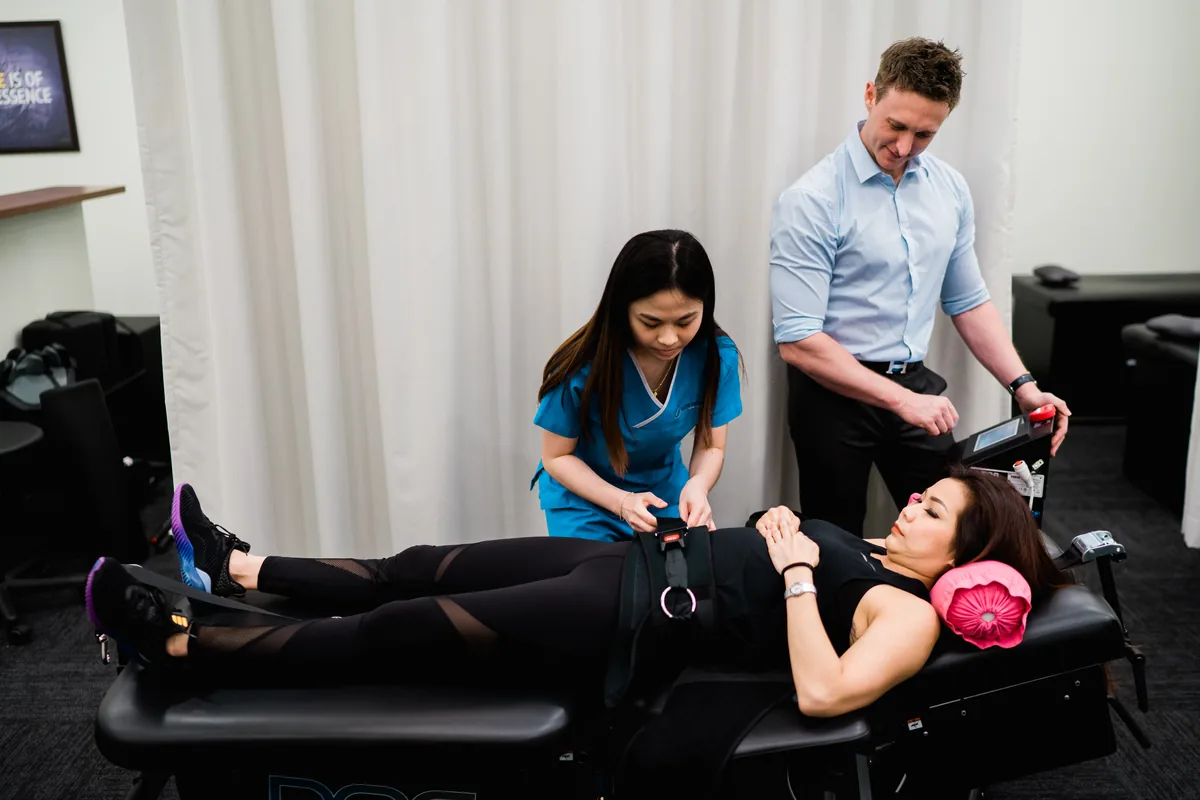
Most slipped discs do not require surgery. Our protocol begins with a full clinical assessment to confirm the diagnosis and identify the affected level, followed by spinal decompression therapy to reduce intradiscal pressure, manual therapy to address the surrounding muscular and joint compensations, and a progressive rehabilitative exercise programme to rebuild stability and prevent recurrence.
Modalities used
Spinal decompression therapy
Chiropractic adjustment
Low-level laser therapy
Radial shockwave therapy
Rehabilitative exercise
What to expect
Most patients begin to notice symptom reduction within four to six sessions. A full structural correction typically takes 8–12 weeks of twice-weekly care, followed by a maintenance phase to consolidate gains.
When a slipped disc needs urgent medical care
Go to an emergency department the same day if you have new difficulty controlling your bladder or bowels, numbness around the groin or inner thighs, or weakness in both legs that is getting worse. These can signal cauda equina syndrome, which needs hospital care and not clinic treatment.
Self-help while you recover
Keep moving in short, gentle walks. Long bed rest usually slows recovery.
Avoid lifting while bent forward and avoid sitting for long stretches. Stand and walk every 30 minutes.
Our patient-care team is happy to walk through anything else over the phone or WhatsApp.
Most slipped discs are treated without surgery first: short-term pain relief, guided movement and manual or chiropractic care. At Elite Spine Centres we add spinal decompression to take pressure off the disc and nerve. Surgery is considered for progressive weakness, loss of bladder or bowel control, or pain that fails a full course of care. Treatment is led by Dr. Michael Bryant, Doctor of Chiropractic (USA), at Parkview Square #14-01, 600 North Bridge Road. The clinic is rated 4.9 from 418 Google reviews.
Yes. Slipped disc is the everyday name for a herniated disc. A bulging disc is an earlier stage, where the outer ring is stretched but not torn. The first step is the same for all three: an examination to find which disc and which nerve are involved, then a plan matched to what we find.
Yes. Chiropractic care is safe and effective for most people with a slipped or herniated disc when performed by a qualified chiropractor. At Elite Spine Centres, we always conduct a thorough assessment before beginning treatment and adapt every technique to your condition. Many patients are surprised by how gentle and immediately relieving the first session feels.
Recovery time varies by severity. Mild to moderate cases often see significant improvement within 4 to 6 weeks of consistent care. More severe or longstanding cases may take several months. Following your personalised plan and making lifestyle adjustments can accelerate recovery and reduce the risk of future flare-ups.
In the majority of cases, yes. Surgery is reserved for severe cases involving major neurological compromise. Most patients respond very well to conservative chiropractic treatment and spinal decompression. Research from Johns Hopkins Medicine supports that most herniated disc patients improve with conservative care including spinal manipulation and physical rehabilitation.
Untreated disc herniation can progress and lead to complications including chronic sciatica, permanent nerve damage, persistent neuropathy in the arms or legs, or in rare cases, cauda equina syndrome with loss of bladder and bowel control. Early treatment is strongly recommended.
This depends on your condition, age, overall health, and how your body responds to care. Some patients notice meaningful improvement in four to six sessions. Others with more chronic presentations require ongoing care over several months. Your chiropractor will reassess regularly and adjust your plan accordingly.
These terms are often used interchangeably. A bulging disc is where the disc expands beyond its normal boundary without rupturing. A herniated or slipped disc involves a tear in the outer layer, allowing the inner material to push through. Both can press on nerves and cause pain, and both can be treated effectively with the right chiropractic care.
Doctor of Chiropractic (USA) · Founder of Elite Spine Centres · Developer of the Functional Correction Method
Dr. Bryant leads the clinic's doctor-led multidisciplinary practice and reviews the clinical information on this page for accuracy.
Book your first visit
Speak to a clinician about what is causing your pain.
Your first visit is a 60-minute session with a doctor — a full assessment and your first treatment in the same appointment. We take your clinical history, screen your posture and movement, explain what we find in plain language, and begin treatment if your condition is suitable for our care.