
Adolescent Idiopathic Scoliosis: A Parent's Guide to Screening, Bracing and Exercise
Adolescent idiopathic scoliosis (AIS) is a sideways curve of the spine, measuring more than 10 degrees on an X-ray, that develops in otherwise healthy children around puberty without a known cause. If your child's school screening has flagged a possible curve, or you have noticed that one shoulder sits higher than the other, you are not alone. A Health Promotion Board study of more than 93,000 Singapore schoolgirls found that the prevalence of AIS rose from 0.27% at age 9 to 2.49% at age 13 (Yong et al., Annals of the Academy of Medicine Singapore, 2009).
Most curves are mild and need monitoring rather than treatment. Some progress during growth, and for those, the right decision at the right time matters. This guide explains the signs to look for, how scoliosis is measured, when bracing is recommended, what exercise can add, and when a surgical opinion is needed.
Key takeaways
- AIS is by far the most common type of scoliosis. It affects children between about 10 and 18 years of age. It is typically picked up around the pre-teen and early teenage years.
- Curves are measured in degrees (the Cobb angle) on an X-ray. Mild curves are monitored; moderate curves in growing children may need a brace.
- In a landmark trial, 72% of braced adolescents avoided progression to the surgical range, compared with 48% of those who were observed (Weinstein et al., 2013).
- Scoliosis-specific exercises such as the Schroth method are part of international conservative-care guidelines. They can be combined with manual therapy and home corrective blocks, and with bracing when bracing is needed.
- AIS does not usually cause pain. Significant or night-time back pain in a child should be assessed by a doctor.
What is adolescent idiopathic scoliosis?
Scoliosis is a three-dimensional curve of the spine: it bends sideways and also rotates, which is why it can make the ribs or shoulder blades stand out on one side. "Idiopathic" means the cause is not known, and "adolescent" means it appears around the growth spurt. The Scoliosis Research Society describes AIS as by far the most common type of scoliosis, affecting children between the ages of 10 and 18 (Scoliosis Research Society).
It is important to know what AIS is not. It is not caused by carrying a heavy school bag, poor posture or sleeping position, and it is not something a parent could have prevented. It is also different from adult scoliosis, which usually develops from wear in the spine later in life; our article on adult scoliosis covers that separately.
What are the signs of scoliosis in teenagers?
Scoliosis in adolescents usually causes no pain, so it is often noticed by a parent, a school screening team or a doctor rather than by the child. The NHS lists signs including a visibly curved spine leaning to one side, uneven shoulders, one shoulder or hip sticking out, the ribs sticking out on one side, and clothes not fitting well (NHS). Other signs to look for include:
- an uneven waistline, with more of a crease on one side
- the head not sitting centrally above the pelvis
- a rib hump on one side that becomes more obvious when your child bends forward to touch their toes
The forward-bend check is the basis of the Adams forward bend test used in screening. A clinician may also use a scoliometer, a small device that measures how much the trunk rotates when your child bends forward.
If your child has significant back pain, pain that wakes them at night, or any numbness, weakness or change in bladder control, this is not typical of AIS and should be assessed by a doctor promptly.
How is scoliosis screened and measured in Singapore?
Scoliosis screening began in Singapore schools in 1982. In the programme described by the Health Promotion Board study, screening teams measured trunk rotation with a scoliometer, and students with a reading of 5 degrees or more were referred to the Student Health Centre for a second check, including an X-ray where needed (Yong et al., 2009). The same study found a significant increase in prevalence between ages 9 and 11, and again at ages 12 to 13, and the authors recommended yearly screening for girls from age 10 to 13.
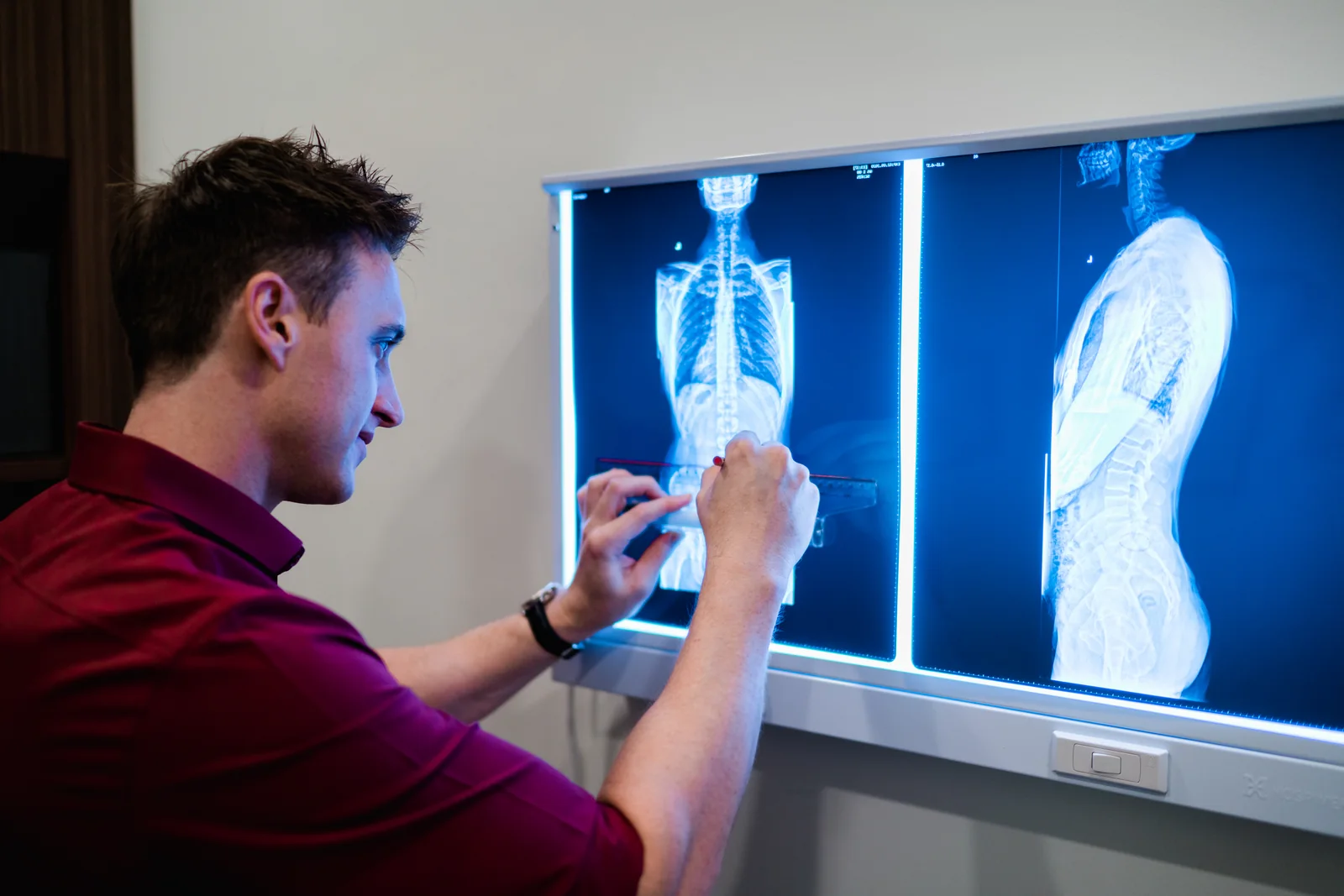
A screening referral is not a diagnosis. The diagnosis is made on a standing X-ray, where the curve is measured as the Cobb angle. A curve of more than 10 degrees is defined as scoliosis; smaller asymmetries are common and usually need no treatment.
How curve size guides management
Management depends on the size of the curve and, just as importantly, how much growth your child has left, because curves are most likely to progress during rapid growth. As a general guide:
- Under about 20 degrees: regular monitoring, often with scoliosis-specific exercise.
- About 20 to 40 degrees in a child who is still growing: bracing is usually considered, alongside exercise.
- Above about 45 to 50 degrees: a surgical opinion is typically recommended, as larger curves are more likely to keep progressing and may need surgical correction.
These thresholds are guides, not rules. Your child's specialist will weigh the curve, its pattern, skeletal maturity and how quickly it has changed.
Does a scoliosis brace work?
For growing adolescents with moderate curves, bracing is the treatment with the strongest evidence. The Bracing in Adolescent Idiopathic Scoliosis Trial (BrAIST), a multicentre study of 242 patients, was stopped early because bracing worked so clearly: 72% of braced patients reached skeletal maturity without their curve progressing to 50 degrees, compared with 48% of those who were observed. Patients were asked to wear the brace for at least 18 hours a day, and success increased with the number of hours worn (Weinstein et al., New England Journal of Medicine, 2013).
The practical lesson for parents is that a brace works when it is worn. Wearing a brace for many hours a day is a real demand on a teenager, physically and socially. Support with comfort, confidence and the exercises that make the brace easier to tolerate often determines whether the prescribed hours are achieved.
Bracing aims to stop a curve getting worse during growth. It is not designed to straighten the spine permanently. Braces usually have to be worn for several years, and many children and teenagers find it hard to keep to the hours. For that reason, Elite Spine Centres tries to avoid bracing where possible. The clinic does not fit braces. When a brace is necessary, it is arranged by your child's orthopaedic specialist outside the clinic.
What can exercise and chiropractic care add?
International guidelines from SOSORT, the society for conservative scoliosis treatment, include physiotherapeutic scoliosis-specific exercises (PSSE) as part of conservative care for idiopathic scoliosis during growth, alongside bracing where indicated (Negrini et al., Scoliosis and Spinal Disorders, 2018). The Schroth method, developed in Germany, is one of the best-known of these approaches. The evidence for exercise on its own is less certain than the evidence for bracing, and the NHS notes that it is not clear whether back exercises improve scoliosis (NHS). Its value lies in supporting posture, strength and comfort alongside monitoring and bracing. Schroth exercise teaches the patient to correct their posture in three dimensions, using specific breathing, positioning and muscle activation matched to their curve pattern.
At Elite Spine Centres, scoliosis care for adolescents combines specific chiropractic adjustments, soft-tissue care and rehabilitative exercise. The exercises draw on the Schroth method, Chiropractic Biophysics (CBP) and other physiotherapeutic exercises matched to the child's curve. Many patients also use scoliosis corrective blocks at home, such as those made by Denneroll and ScoliCare. The aim is to stabilise the curve and, in some cases, reduce it. Clinicians track progress through regular reassessment and X-ray monitoring.
Most of the children we see are between 8 and 12 years old, often referred after a school screening or because a parent noticed a change. Most do not need to be co-managed with an orthopaedic specialist. We involve one when a curve is severe or progressing quickly and surgery is being considered. Exercise and manual therapy are not a substitute for a brace or surgery when those are indicated.
Our article on chiropractic for scoliosis explains what conservative care can and cannot do in more detail.
When does scoliosis need a surgical opinion?
A surgical opinion is usually recommended when a curve reaches the mid-40s to 50 degrees, or when it is progressing quickly despite bracing. Surgery is also considered when the scoliosis is not idiopathic, for example when it is linked to a neurological or congenital condition. Honest advice matters here: conservative care is valuable for mild and moderate curves, but a large or rapidly progressing curve should always be reviewed by a spine surgeon.
Speak to the Team at Elite Spine Centres
If your child has been flagged at school screening or diagnosed with a mild or moderate curve, the team at Elite Spine Centres can explain what the findings mean and whether scoliosis-specific exercise could be a suitable part of their treatment plan. To book a consultation, call +65 6904 8400 or message us on WhatsApp at +65 9727 3603.
Frequently Asked Questions
At what age does adolescent idiopathic scoliosis appear?
AIS typically appears from about age 10 until the end of growth. The Singapore Health Promotion Board study found prevalence among girls rising from 0.27% at age 9 to 2.49% at age 13, which is why screening focuses on the upper primary and lower secondary years.
Can scoliosis be corrected without surgery?
For mild and moderate curves, conservative care aims to stop progression and improve posture and comfort. Bracing prevented progression to the surgical range in 72% of braced patients in the BrAIST trial. Exercise and manual therapy support this, but a straight spine cannot be promised.
Is scoliosis caused by bad posture or heavy school bags?
No. Idiopathic scoliosis has no known cause, and it is not caused by posture, school bags or sleeping position. Postural asymmetry can look similar, which is why an X-ray measurement is needed to confirm a diagnosis.
Does scoliosis get worse after growth stops?
According to the Scoliosis Research Society, most curves slow their progression significantly once growth ends, but some, especially curves greater than 60 degrees, continue to progress during adulthood. This is why larger curves continue to be monitored after growth stops.
Can my child still play sport with scoliosis?
In most cases, yes. Staying active is encouraged for children with AIS. If your child wears a brace, their specialist will advise on when to remove it for sport.
Sources
- Yong F, Wong HK, Chow KY. Prevalence of adolescent idiopathic scoliosis among female school children in Singapore. Annals of the Academy of Medicine Singapore, 2009. PubMed 20052440
- Weinstein SL et al. Effects of bracing in adolescents with idiopathic scoliosis. New England Journal of Medicine, 2013. PubMed 24047455
- Negrini S et al. 2016 SOSORT guidelines: orthopaedic and rehabilitation treatment of idiopathic scoliosis during growth. Scoliosis and Spinal Disorders, 2018. PubMed 29435499
- NHS. Scoliosis. nhs.uk/conditions/scoliosis
- Scoliosis Research Society. Idiopathic scoliosis. srs.org
This article is for general information and does not replace a diagnosis from a qualified healthcare professional. Please consult a qualified practitioner about your child's individual situation.
Speak to a clinician about what is causing your pain.
Your first visit is a 60-minute session with a doctor — a full assessment and your first treatment in the same appointment. We take your clinical history, screen your posture and movement, explain what we find in plain language, and begin treatment if your condition is suitable for our care.