
Shockwave therapy in Singapore — for tendinopathies that have plateaued on manual therapy.
Targeted acoustic-wave therapy that breaks down adhesion in chronic tendon and fascial injury. Most effective for plantar fasciitis, tennis or golfer's elbow, shoulder tendinopathy, and frozen-shoulder mobilisation.
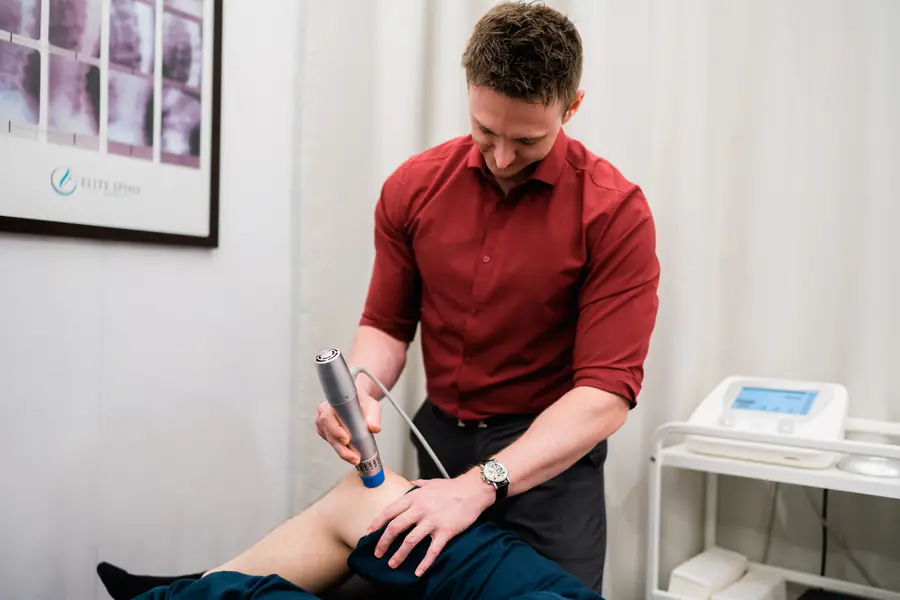
What radial shockwave therapy is
Radial shockwave therapy, also called extracorporeal shockwave therapy, is a non-invasive treatment for localised musculoskeletal pain. It sends rapid percussive shock waves into soft tissue and the outer layers of bone.
The effect is a controlled re-injury at a cellular level, which breaks up the scarring that builds in muscle, tendon, ligament and fascia over months or years of a problem going untreated. That controlled stimulus prompts the body to increase production of bone-forming cells and of micro blood vessels. The new blood supply to an old, damaged area means faster healing and better nutrient delivery to the tissue that is trying to repair.
How shockwave therapy works
Inside the handpiece, a projectile is programmed to move up and down at a set frequency and power, striking a metal applicator head repeatedly. That produces a series of shock waves that travel several centimetres into the tissue. The energy causes a hyper-stimulation effect that many patients feel as relief over the treated area almost immediately.
The same controlled impulses set off a chain of cellular reactions that improve blood flow and tissue repair, including in areas that have been damaged for a long time. Three mechanisms are usually credited for the result:
- The shock waves stimulate a metabolic reaction in the affected tissue.
- They break down fibrous adhesions between tissues, which restores movement.
- They trigger a pain-blocking response, so fewer pain messages reach the brain.
Conditions treated with shockwave therapy
Radial shockwave therapy is used for:
- Shoulder tendonitis and rotator cuff injury
- Plantar fasciitis and heel spurs
- Tendonitis of the knee, including jumper's knee
- Tendonitis of the foot
- Golfer's elbow and tennis elbow
- Calcifications in soft tissue
- Painful muscle trigger points
- Frozen shoulder during the mobilisation phase
- Most conditions causing pain or poor soft tissue mobility
The treatment sequence
A shockwave session runs in three steps.
Step one — locating the area
The doctor finds and marks the area to be treated by palpation, so the therapy is delivered to the right place.
Step two — applying gel
A friction-reducing gel goes onto the target area. The gel is what allows the percussion waves to transfer into the tissue smoothly and efficiently.
Step three — delivering the impulses
The applicator is pressed into the area and a set number of impulses is delivered to each section.
What to expect during a shockwave therapy session
Initial assessment
Before any shockwave treatment starts, we assess whether the condition is suitable for it. If it is not, we say so and recommend something else.
Preparing for treatment
You sit or lie in a position that gives access to the injured area, and a water-based gel is applied to the skin around it so the probe moves smoothly and the sound waves transmit properly.
During the session
The handheld probe is placed on the injured area and delivers controlled low-energy sound waves into the tissue. You may hear a ticking or clicking sound while it does.
What it feels like. The pulsing feels like a strong tapping underneath the skin. How much it hurts varies from person to person, and most people describe it as uncomfortable rather than painful. It depends partly on where the probe is directed, as areas with less skin and muscle over the bone are more sensitive. Intensity starts low and is increased gradually, staying within what you can tolerate comfortably. Around five out of ten on a pain scale is the level that works best.
How long it takes. Treatment itself usually runs 5 to 10 minutes per area. The full appointment can take up to 30 minutes.
After treatment
You can normally return to your usual activities straight away. Some redness or swelling around the treated area is possible, and occasionally pain increases for a short period. Avoid anti-inflammatory painkillers afterwards, because they interrupt the healing response the treatment is trying to start. Resting the area and avoiding high-impact sport for 24 to 48 hours is sensible.
Results and treatment schedule
Some patients notice improvement within the first few sessions and others take longer. Results depend on the condition being treated and on how your body responds. If you see no change, tell us, so we can look for another cause of the pain rather than keep going.
The schedule depends on the injury. Some conditions are treated weekly; for others, two or three treatments spread over six to twelve weeks is enough. Shockwave is often paired with a rehabilitation plan, and we discuss which other treatments we recommend during the session.
Who it is for
- Plantar fasciitis and heel pain
- Tennis and golfer's elbow
- Shoulder tendinopathy
- Patellar tendinopathy
- Frozen shoulder (mobilisation phase)
Contraindications + honest screening
Areas over active infection, malignancy, an open wound, or near a pacemaker. Not used on the abdomen during pregnancy. We confirm safety before the first treatment.
What a session looks like
Each session is 15–20 minutes per treated area. Most patients feel improvement within the first three to four sessions.
Typical treatment arc
4–8 sessions over 4–6 weeks for most tendinopathies.
Where this service fits
- Radial shockwave therapy is one component of the broader Functional Correction Method — used in isolation only where a multi-modal plan is not clinically indicated.
- Each session is preceded by a brief reassessment so the treatment evolves with the patient.
- If this modality is not the right fit for your condition, we will say so at the first consultation.
Common questions.
Our patient-care team is happy to walk through anything else over the phone or WhatsApp.
Many patients suffering from chronic pain symptoms have tried various types of treatments with no success. Up to 80 percent of said patients worldwide reported successful treatment of the problem using shockwave therapy or shockwave combined with other therapies when indicated.
You might experience a very minimal feeling of discomfort or prickling sensation during the treatment, depending on the level of pain you are already experiencing in the affected area. Fortunately, since the treatment will only last around 4-8 minutes per session, the slight feeling of discomfort is often tolerable by most patients.
The number of treatment will vary depending on the tissue response and indication. Since the treatment’s effect is cumulative, most patients will start to notice benefits of shockwave within a few sessions. In many cases, patients have reported already experiencing some relief after the just their first treatment.
Most indications may require anywhere from around 4-10 sessions, which would normally be done from 3 to 7 days apart. However, the frequency and intervals will still vary depending on your condition, tissue response and tolerance.
Most patients report immediate relief from pain following the treatment. However, within a few hours after the procedure until the day after, you might experience some soreness in the treated area. Fortunately, many report the soreness as non-limiting and tolerable. We also advise patients new to shockwave therapy to apply a cold compress to the treated area on days of treatment to reduce inflammation and soreness which may result.
It is recommended that you refrain from any physical activity that can stress the treated region the first 48 hours after the treatment session. As patients improve, restrictions on activities may be lifted or modified as necessary.
In the late 1960s, German researchers began to study how shockwaves impacted the human body. They discovered that shockwaves impacted the body in lots of different ways. After discovering that they could help break up kidney stones to make them easy to pass, shockwave therapy was mainly used for this purpose.
In the 1990s, the effects of high-energy shockwave therapy on soft tissue injuries were studied. Both low-energy and high-energy shockwave treatments were found to be effective. This has led to it being used to treat chronic injury and pain today.
Shockwave therapy in Singapore is a non-invasive medical treatment that uses high-energy sound waves to stimulate healing in damaged soft tissues and musculoskeletal conditions. The shockwaves increase the metabolism and blood flow, accelerating the body’s natural healing process.
It can also break down calcium deposits. Some conditions effectively treated by extracorporeal shockwave therapy include plantar fasciitis and chronic tendon disorders.
The treatment is applied using a handheld device which applies a mechanical, not electrical, shockwave to the affected area through the skin. The ESWT machine has a number of interchangeable heads that direct stimulation over a precise or wider area.
The machine uses compressed air to accelerate a projectile up to 62mph within a tube. The projectile hits the head of the applicator, converting energy into acoustic pressure waves. These waves can penetrate up to 6cm, depending on which head is used on the handheld applicator. This can penetrate tissue deeper than a massage.
These soundwaves kick-start an inflammatory response as part of the body’s healing mechanisms. It also increases blood flow to the injured tissues. The therapy can also reduce pain sensitivity by overstimulating the nerves and can break down calcium deposits in tendons.
Research shows that shockwave therapy delivers mechanical force to body tissue, stimulating the metabolism and blood flow to produce healing. This is beneficial to tendons as they typically don’t get much blood supply and heal slowly. The shockwaves promote regrowth and healing of bone and tissue. This can provide a non-surgical treatment option for many chronic conditions and may help some patients avoid invasive procedures. It can also help clients avoid repeated steroid injections which can lead to breakdown of tissue over time.
When it comes to fractures, by using targeted shockwaves inside the bone this can create cavities in which a hematoma can form. A hematoma is a pool of blood similar to a bruise that occurs as part of the body’s natural healing mechanism.
By inducing a hematoma, you can help the body remove damaged bone cells and encourage healthy bone to grow and properly reconnect.
Shockwave therapy in Singapore can be effective treatment for a number of conditions. It is particularly useful for soft tissue injuries, tendon issues and bone and joint injuries.
Research suggests shockwave therapy may be beneficial for a range of musculoskeletal conditions, including:
- Tennis elbow: (Lateral epicondylitis).
- Golfer’s elbow: (Medial epicondylitis).
- Jumper’s knee: (Patellar tendinopathy).
- Achilles tendinopathy.
- Hamstring tendinopathy.
- Shoulder tendinopathy.
- Heel spurs.
- Calcific tendonitis: (especially in the shoulder).
- Greater trochanteric pain syndrome: (lateral hip pain).
- Trochanteric bursitis: (hip pain).
- Facet joint inflammation.
- Plantar fasciitis: (heel and foot pain).
- Shin splints: (medial tibial stress syndrome).
- Iliotibial (IT) band syndrome.
- Muscular trigger points.
- Chronic back and neck dysfunction.
- Carpal tunnel syndrome.
The effectiveness of shockwave therapy can vary depending on the specific condition, its severity, and individual patient factors. During your consultation, we’ll assess whether shockwave therapy is appropriate for your particular situation.
Many clinics in Singapore now offer shockwave therapy, so what makes Elite Spine Centres different?
Integrated Approach: We don’t just offer shockwave therapy in isolation. Our chiropractors assess your overall biomechanics and movement patterns to understand why your injury developed and hasn’t healed. This means we can combine shockwave therapy with chiropractic adjustments, rehabilitation exercises, and lifestyle modifications for more comprehensive results.
Experienced Practitioners: Our therapists are trained in proper shockwave application techniques and understand how to adjust treatment intensity for maximum effectiveness and comfort.
Personalized Treatment Plans: We don’t believe in one-size-fits-all protocols. Your shockwave therapy program is customized based on your specific condition, pain tolerance, and recovery goals.
Comprehensive Assessment: Before recommending shockwave therapy, we conduct a thorough evaluation to ensure it’s the right treatment for your condition. If it’s not, we’ll recommend alternatives that may be more effective.
Ongoing Support: Your treatment doesn’t end when the shockwave session is over. We provide rehabilitation exercises, lifestyle advice, and follow-up care to ensure lasting results.
Dr. Michael Bryant
Doctor of Chiropractic (USA) · Founder of Elite Spine Centres · Developer of the Functional Correction Method
Dr. Bryant leads the clinic's doctor-led multidisciplinary practice and reviews the clinical information on this page for accuracy.
Speak to a clinician about what is causing your pain.
Your first visit is a 60-minute session with a doctor — a full assessment and your first treatment in the same appointment. We take your clinical history, screen your posture and movement, explain what we find in plain language, and begin treatment if your condition is suitable for our care.