
Plantar Fasciitis: Causes, Symptoms and Non-Surgical Treatment Options
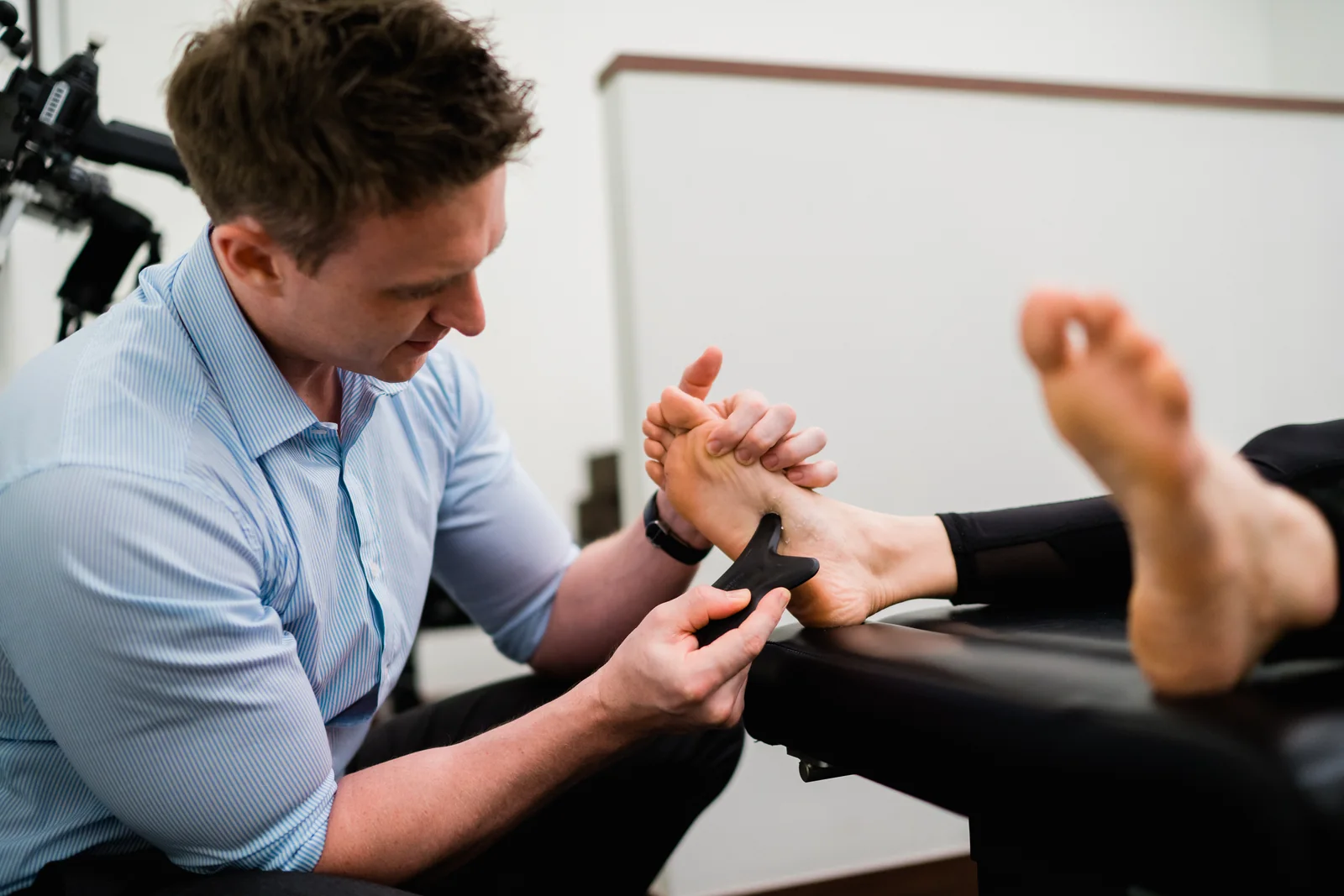
Plantar fasciitis is pain and irritation of the plantar fascia, the thick band of tissue that runs along the sole of the foot from the heel bone to the toes and supports the arch. It is the most common cause of heel pain in adults; a review in American Family Physician estimates that one in 10 people will experience it in their lifetime (Trojian and Tucker, American Family Physician, 2019). Whether your heel pain has come on suddenly or has been building over months, it is worth understanding what drives it, because the cause shapes the treatment.
The same review notes that with proper treatment, 80% of patients improve within 12 months. That is reassuring, but a year is a long time to limp through, which is why a structured plan matters.
Key takeaways
- Plantar fasciitis causes sharp heel pain that is typically worst with the first steps in the morning or after a period of rest.
- Researchers increasingly call it plantar fasciopathy, because the tissue shows degeneration and overload rather than ongoing inflammation.
- Main risk factors are limited ankle flexibility, higher body weight and long periods of standing. It affects runners and sedentary people alike.
- Most people improve with conservative care. Stretching and load management come first, with shockwave therapy an evidence-supported option for pain that persists.
- Tingling, numbness, night pain or swelling point to something other than plantar fasciitis and need a proper assessment.
What causes plantar fasciitis?
Plantar fasciitis develops when the load placed on the plantar fascia exceeds its capacity to recover. The American Family Physician review lists limited ankle dorsiflexion (how far the foot can bend upwards), increased body mass index and prolonged standing as the main risk factors, and notes that the condition is common in runners but also affects sedentary people (Trojian and Tucker, 2019). The same review explains that "plantar fasciopathy" is a more accurate name, because the condition is not primarily inflammatory.
In practice, several factors usually combine:
- Tight calf muscles and a stiff ankle. When the ankle cannot bend upwards freely, more strain passes through the arch with every step.
- A sudden change in load. Starting a running programme, a long holiday on foot, or a new job that involves standing all day.
- Footwear. Unsupportive or very flat shoes, flip-flops and walking barefoot on hard floors all increase strain on the fascia.
- Body weight. Higher body weight increases the load on the heel with every step.
- Movement higher up the chain. Hip and knee mechanics influence how the foot lands, which is why a clinician will look beyond the foot itself.
That last point is often overlooked. Heel pain is felt in the foot, but the way the ankle, knee and hip share load decides how much work the plantar fascia has to do. Treatment that addresses only the heel can ease pain for a time, while the load that caused it remains unchanged.
What are the symptoms of plantar fasciitis?
The typical symptom is a stabbing, non-radiating pain under the front of the heel that is worst with the first steps in the morning (Trojian and Tucker, 2019). The NHS adds that the pain usually eases once you start moving, returns after standing, walking or running for a long time, and is often felt when stretching the sole of the foot, for example when climbing stairs (NHS).
Plantar fasciitis is diagnosed mainly through history and examination, with tenderness at the point where the fascia attaches to the heel bone. Ultrasound can be useful when pain persists beyond three months despite treatment.
When heel pain may be something else
Not all heel pain is plantar fasciitis. Pain at the back of the heel suggests the Achilles tendon; our foot pain treatment page explains how the two are told apart. Tingling, burning or numbness in the foot suggests nerve involvement. Pain at night or at rest, significant swelling, or pain after a fall should also be assessed. The NHS advises seeing a doctor if you have tingling or loss of feeling in the foot, or if you have diabetes and foot pain, because foot problems can be more serious with diabetes (NHS).
How long does plantar fasciitis last?
With proper treatment, 80% of patients improve within 12 months (Trojian and Tucker, 2019). Many people improve much sooner once the load on the foot is managed and the calf and fascia are stretched regularly. The NHS recommends seeing a doctor if heel pain has not improved after two weeks of self-care, if it is severe, or if it keeps coming back (NHS).
Pain that has lasted for several months is not unusual, but it is a signal that self-care alone is not enough. At that stage a clinical assessment can identify what is keeping the tissue overloaded.
Which treatments help plantar fasciitis?
Treatment should start with stretching of the plantar fascia, ice massage and simple pain relief, according to the American Family Physician review, which also notes that many standard treatments such as night splints and orthoses have not shown benefit over placebo (Trojian and Tucker, 2019). The NHS recommends rest, ice, cushioned supportive shoes, gentle stretching of the sole and heel, and low-impact exercise such as swimming (NHS).
Self-care that is worth doing
- Stretch the calf and the sole of the foot several times a day, especially before the first steps in the morning.
- Reduce the activities that clearly aggravate the pain for a period, rather than stopping all activity.
- Wear supportive, cushioned shoes and avoid walking barefoot on hard floors.
- Build back up gradually once pain settles, particularly if you run.
Shockwave therapy for persistent heel pain
For pain that does not settle with self-care, radial shockwave therapy is one of the better-studied options. A 2024 meta-analysis of 11 studies found that shockwave therapy, including the radial type, reduced pain intensity in plantar fasciopathy and was well tolerated, while noting that treatment settings influence results (Lippi et al., European Journal of Physical and Rehabilitation Medicine, 2024). More broadly, shockwave has been shown to be effective for a wide range of soft-tissue problems, and plantar fasciopathy is one of the conditions where it has been studied most.
Radial shockwave delivers rapid pressure waves into the affected tissue through a handheld applicator. This mechanical stimulus prompts a local healing response and helps break down fibrous tissue; patients typically feel reduced pain over a course of sessions. At Elite Spine Centres, the treatment itself takes 5 to 10 minutes within a session of up to 30 minutes, and a course is usually 4 to 10 sessions spaced 3 to 7 days apart. Mild soreness afterwards is expected. Patients are advised to avoid high-impact sport for 48 hours and to avoid anti-inflammatory painkillers after treatment, because these can dampen the healing response the therapy is designed to trigger. Our article on what shockwave therapy treats explains the therapy in more detail.
Treating the chain, not only the heel
Shockwave therapy works best alongside measures that reduce the load on the fascia. A clinician may combine it with soft-tissue therapy for tight calf muscles, joint mobilisation for a stiff ankle, and rehabilitative exercises that strengthen the foot and calf. Where the way you walk or run is contributing, the plan will address the knee and hip as well. Clinicians also give practical advice on footwear and orthotics where needed, along with supportive exercises to do between shockwave sessions.
For pain that persists despite good conservative care, a medical doctor may discuss injections or, less commonly, surgery. It is worth speaking to a professional to find out which options could be a suitable part of your treatment plan.
Speak to the Team at Elite Spine Centres
If heel pain is affecting how you walk, work or train, the team at Elite Spine Centres can assess what is driving it and put together a personalised treatment plan. To book a consultation, call +65 6904 8400 or message us on WhatsApp at +65 9727 3603.
Frequently Asked Questions
What is the main cause of plantar fasciitis?
There is rarely one cause. The American Family Physician review identifies limited ankle flexibility, higher body mass index and prolonged standing as the main risk factors. A sudden increase in walking, running or standing, and unsupportive footwear, commonly tip the balance.
Why is plantar fasciitis worse in the morning?
The plantar fascia and calf tighten during rest. The first steps after sleep suddenly stretch this tissue, which produces the characteristic sharp heel pain. Gentle calf and foot stretches before getting out of bed can reduce it.
Is walking good for plantar fasciitis?
Some walking is fine and helps keep the tissue healthy, but long periods of walking or standing tend to aggravate it. The NHS suggests reducing prolonged walking and standing while symptoms settle, and choosing low-impact exercise such as swimming.
Does shockwave therapy work for plantar fasciitis?
A 2024 meta-analysis of 11 studies found that shockwave therapy, including radial shockwave, reduced pain in plantar fasciopathy and was well tolerated. It is generally considered for heel pain that has not improved with stretching and load management.
When should I see someone about heel pain?
The NHS recommends seeing a professional if pain has not improved after two weeks of self-care, is severe, keeps returning, or comes with tingling or numbness. People with diabetes should have foot pain checked promptly.
Sources
- Trojian T, Tucker AK. Plantar Fasciitis. American Family Physician, 2019. aafp.org
- NHS. Plantar fasciitis. nhs.uk/conditions/plantar-fasciitis
- Lippi L et al. Efficacy and tolerability of extracorporeal shock wave therapy in patients with plantar fasciopathy: a systematic review with meta-analysis and meta-regression. European Journal of Physical and Rehabilitation Medicine, 2024. PubMed 39257331
This article is for general information and does not replace a diagnosis from a qualified healthcare professional. Please consult a qualified practitioner about your individual situation.
Speak to a clinician about what is causing your pain.
Your first visit is a 60-minute session with a doctor — a full assessment and your first treatment in the same appointment. We take your clinical history, screen your posture and movement, explain what we find in plain language, and begin treatment if your condition is suitable for our care.