What scoliosis is
Scoliosis is a sideways curvature of the spine measuring more than 10 degrees on an X-ray, often forming an "S" or "C" shape. In many cases the vertebrae also rotate, so the shoulders and hips sit unevenly or the rib cage looks asymmetrical.
Because the spine supports the body, protects the spinal cord and allows movement, an abnormal curve places uneven stress on the surrounding muscles, joints and ligaments. Scoliosis develops most commonly in adolescence, but it can also appear in adults as the spine degenerates with age.
Causes and risk factors
The exact cause of scoliosis has not been fully determined. These factors are associated with a higher risk:
- A family history of scoliosis
- Rapid growth spurts during puberty, particularly in girls
- Neuromuscular conditions such as cerebral palsy or muscular dystrophy
- Spinal abnormalities present from birth
- Age-related degeneration of the spine in older adults
- Uneven leg length, which can add to postural imbalance
Poor posture alone is not a primary cause of scoliosis. It can, however, worsen discomfort and muscular imbalance in someone who already has the condition, which is why posture correction often forms part of a wider care plan.
Signs and symptoms of scoliosis
Scoliosis presents differently depending on severity, age and the type of curve. Many adolescents with a mild curve have few or no symptoms, while adults with degenerative scoliosis often live with more persistent pain and stiffness.
Visual signs
- One shoulder or hip sits higher than the other
- One shoulder blade sticks out more than the other
- A rib hump that shows when bending forward
- The body leans or tilts to one side
- An uneven or tilted waistline
- Clothes that hang unevenly across the shoulders or hips
Physical symptoms
- A dull ache in the lower or mid back
- Muscle fatigue after long periods of sitting or standing
- Numbness or weakness in the legs and feet
- Stiffness that limits range of movement
- Shortness of breath in severe cases
- A gradual loss of height as the curve progresses
If you notice any of these signs, have the spine assessed early. Our back pain treatment page covers the related spinal pain in more detail.
Types of scoliosis
Idiopathic scoliosis
The most common type, accounting for around 80% of cases. The cause is unknown, though genetics is believed to play a part. It is grouped by age of onset: infantile (0 to 3 years), juvenile (3 to 10 years) and adolescent (10 to 18 years). Adolescent idiopathic scoliosis is most often diagnosed during growth spurts and is more common in teenage girls.
Congenital scoliosis
The spine develops abnormally before birth, with one or more vertebrae malformed or fused. The curve becomes more obvious as the child grows, although pain is often minimal early on.
Neuromuscular scoliosis
Develops alongside conditions such as cerebral palsy or muscular dystrophy, where muscle weakness or imbalance undermines the stability of the spine.
Degenerative scoliosis
An adult-onset form caused by age-related change in the spine, including disc degeneration, arthritis and osteoporosis. It tends to cause more persistent pain than the adolescent forms. Our guide to adult scoliosis covers it in more depth.
How scoliosis is diagnosed
Diagnosis combines a physical examination, a review of your history and imaging. Early detection matters most for children and adolescents, because a curve can progress quickly during a growth spurt.
Physical examination
The Adams forward bend test is the usual first screen. You bend forward at the waist with your arms hanging freely, and the clinician checks for uneven shoulders, a prominent shoulder blade, a rib hump or a visible curve. A scoliometer may be used to measure how far the trunk is rotated.
Your history
The clinician asks about scoliosis in the family, recent growth spurts, back pain, any numbness or weakness, and known neurological or muscular conditions. This helps establish the type of scoliosis and how likely it is to progress.
X-ray and the Cobb angle
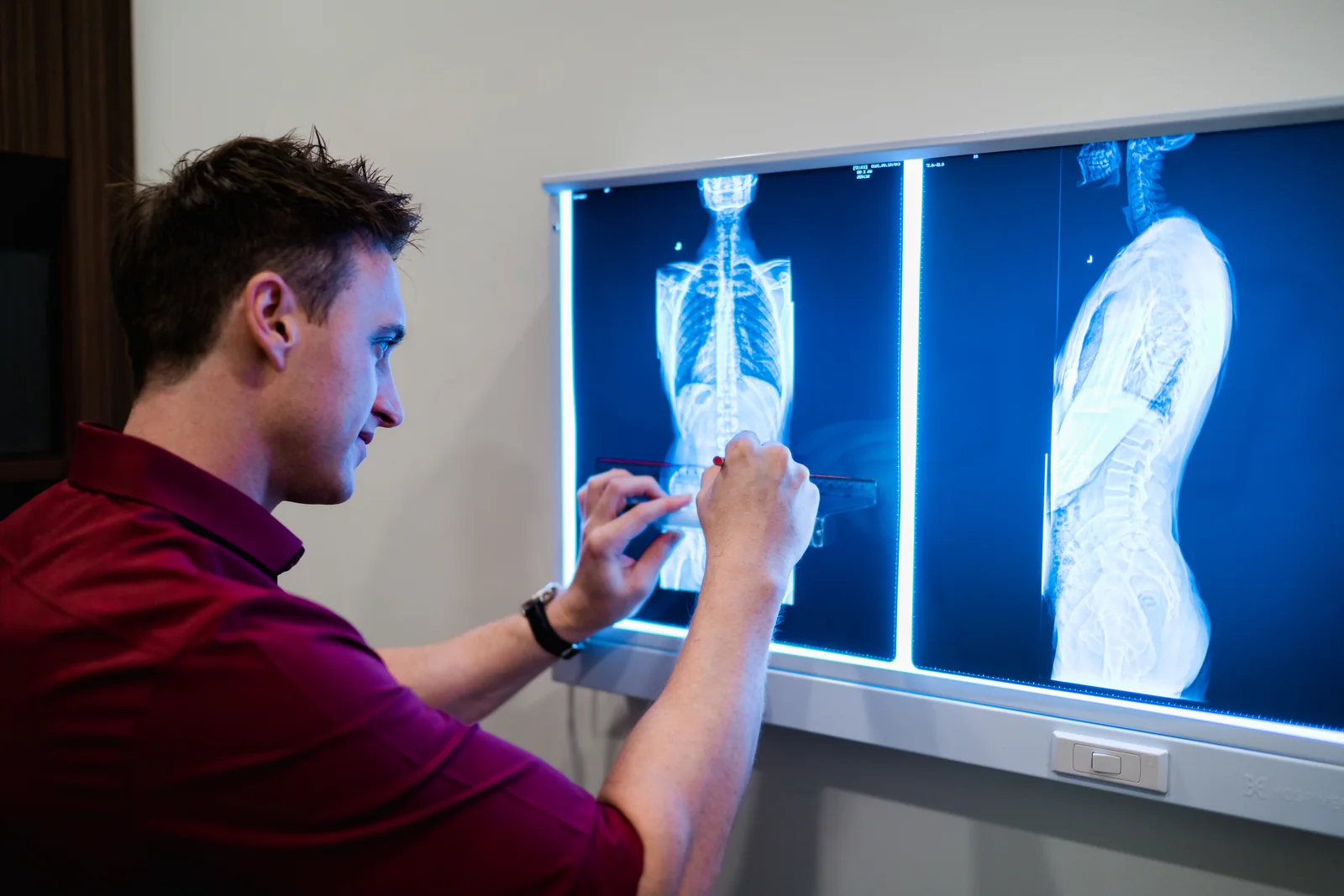
An X-ray is the most reliable way to confirm scoliosis. The Cobb angle measured on it shows whether a curve is present, how severe it is, and where it sits. As a general guide:
- 10 to 25 degrees: mild
- 25 to 40 degrees: moderate, where bracing is often considered for adolescents who are still growing
- Over 40 degrees: severe, where a surgical opinion may be recommended
Further imaging
An MRI is ordered when there are neurological symptoms or the curve pattern is unusual. A CT scan gives a detailed view of the bone, and a bone age test estimates how much growth an adolescent has left. If you already have imaging, bring it to your first visit and the doctor will review it.
Ongoing monitoring
Children and adolescents with a mild curve are typically reviewed every four to six months while they are growing. For adults, repeat imaging shows whether the curve is stable or progressing.
Scoliosis treatment options in Singapore
Treatment depends on the type and severity of the curve and the age of the patient:
- Observation. Mild curves, particularly in children, may simply be monitored to make sure they do not worsen.
- Chiropractic care. A non-invasive approach to managing symptoms, improving spinal mobility, reducing pain and supporting long-term spinal health. It suits mild to moderate curves in particular.
- Bracing. Typically recommended for adolescents with curves of 25 to 40 degrees, to limit progression until the skeleton matures.
- Surgery. Reserved for severe curves, usually beyond 40 to 60 degrees, or significant neuromuscular involvement.
We work alongside orthopaedic management where it is needed, and we will refer you on if our care is not the right path.
Chiropractic scoliosis treatment at Elite Spine Centres
Chiropractic care does not cure scoliosis. It is a non-invasive way to manage it: reducing pain, improving joint mobility, supporting muscular balance and helping to slow progression, without surgery, recovery time or a reliance on medication. It is most useful for:
- Adolescents managing muscular discomfort and postural imbalance while they grow
- Adults with degenerative scoliosis who want to reduce persistent pain and avoid surgery
- Anyone who wants to keep the spine healthy without medication or invasive procedures
The Functional Correction Method
No two curves are the same, so every plan is built around the individual. Our Functional Correction Method combines four elements under one roof:
- Chiropractic techniques, including spinal adjustments, to improve joint mobility and reduce strain around the curve
- Manual soft tissue therapy to ease the tension scoliosis creates, since muscles tend to be tight on one side and weak on the other
- Rehabilitation exercises for the core, posture and breathing, matched to your curve pattern
- Supporting technologies such as spinal decompression and low-level laser therapy
What to expect
Scoliosis management is long-term. Most adolescent patients benefit from a sustained programme through to skeletal maturity. Adults typically follow an active phase of 3 to 6 months, with more frequent visits to settle pain and stiffness, then a maintenance phase with periodic visits. Your clinician will set out the schedule after your first assessment.
If this matches your symptoms
- Most cases of scoliosis are non-surgical when treated with the right protocol.
- Every patient begins with a 60-minute first visit — a full assessment and first treatment with a doctor, for $88 online.
- If our care is not the right path for your condition, we will say so and refer you on.