


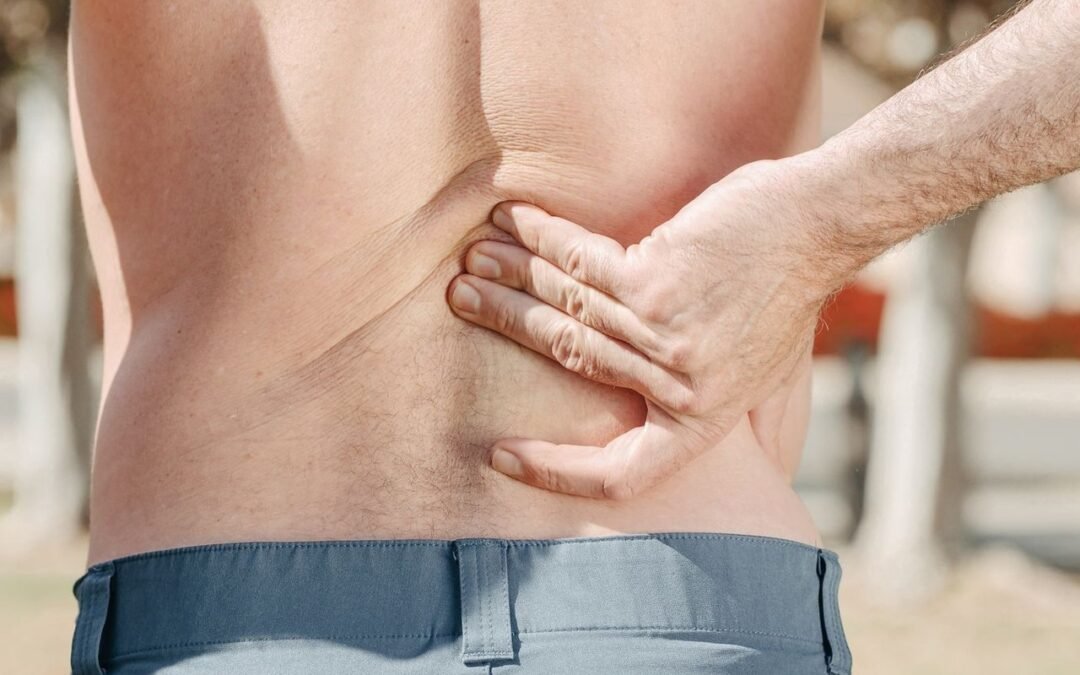
Most pain in the back is not from a single source. It is usually a combination of factors — muscle and soft tissue tension, joint dysfunction, disc involvement, and sometimes nerve involvement — contributing in different proportions to the symptoms you feel. Recognising this matters because some back pain has a quality that points more strongly toward disc involvement than to muscular strain alone: it persists, it spreads down into the buttock or leg, it worsens when you sit for too long or cough unexpectedly. When that pattern is present, a slipped disc is one of the more likely contributors — and the assessment to confirm it is structural rather than guesswork.
Understanding the signs of a slipped disc — and knowing when they warrant professional attention — is the first step toward addressing the root cause rather than managing symptoms that keep returning.
- A slipped disc occurs when the soft inner material of a spinal disc pushes through a tear in the outer casing, pressing on nearby nerves
- Symptoms often include back pain, radiating leg pain, numbness, tingling and muscle weakness
- Not all slipped discs cause severe pain — some produce intermittent discomfort that patients dismiss for months
- Most slipped discs can be treated without surgery using non-invasive approaches including spinal decompression and chiropractic care
- Persistent symptoms lasting more than two weeks, or symptoms accompanied by leg weakness or numbness, warrant a clinical assessment
What Is a Slipped Disc?
The spine is made up of vertebrae stacked on top of one another, separated by intervertebral discs. Each disc acts as a shock absorber — it has a tough outer ring called the annulus fibrosus and a soft, gel-like centre called the nucleus pulposus. A slipped disc — also referred to as a herniated disc, prolapsed disc or bulging disc — occurs when the nucleus pushes through a weakness or tear in the outer ring.
When the disc material protrudes, it can press against nearby spinal nerves. This compression is what produces many of the characteristic symptoms: the radiating leg pain, the numbness in the foot, the weakness when trying to lift the toes. The disc itself does not have pain receptors, but the nerves it compresses do.
Slipped discs most commonly occur in the lower back (lumbar spine), though they can also occur in the neck (cervical spine). The symptoms vary depending on where the disc is located and which nerves are affected.
Common Signs and Symptoms of a Slipped Disc
The signs of a slipped disc do not always present dramatically. Some patients notice a gradual increase in back discomfort over weeks or months. Others experience a more sudden onset — often after a particular movement, lift, or period of prolonged sitting. Here are the most common indicators.
Back pain with a different quality
Muscular back pain tends to be aching, localised, and responsive to movement and rest. Disc-related pain often has a deeper, more persistent quality. It may worsen when you remain in one position for too long, improve briefly with movement, then return. Pain that follows a consistent pattern — worse in the morning, worse after sitting, worse when you cough or sneeze — is more likely to have a structural origin than a purely muscular one.
Pain that travels down the leg
When a slipped disc in the lower back presses on the sciatic nerve, the result is a radiating pain that travels from the lower back through the buttock, down the back of the thigh, and sometimes into the calf or foot. This is known as sciatica. It is not a separate condition — it is a symptom of nerve compression, often caused by a disc herniation at the L4-L5 or L5-S1 level. The pain can range from a dull ache to a sharp, burning sensation.
Numbness or tingling in the leg, foot or toes
Nerve compression does not only cause pain — it can also produce sensory changes in the areas supplied by the affected nerve. Numbness, a pins-and-needles sensation, or a feeling that part of the leg or foot has gone to sleep are all consistent with disc-related nerve compression. These sensations may come and go, or they may be persistent. Either way, they signal that a nerve is under pressure and the underlying cause needs to be assessed.
Muscle weakness in the leg or foot
More advanced nerve compression can interfere with the motor signals the nerve carries, resulting in weakness. This might manifest as difficulty lifting the front of the foot (a condition called foot drop), difficulty walking on tiptoes, or a general feeling that one leg is weaker than the other. Muscle weakness is a sign that the nerve compression is significant enough to affect function rather than just sensation.
Pain that worsens with specific postures or movements
Patients with a slipped disc often notice that certain positions make their pain considerably worse. Prolonged sitting — particularly in a car or at a desk — increases intradiscal pressure and tends to aggravate symptoms. Bending forward, coughing, sneezing, or straining during a bowel movement can produce a sharp increase in pain. Lying down, by contrast, often provides partial relief by reducing the load on the affected disc.
What Causes a Slipped Disc?
Slipped discs do not usually occur because of a single dramatic event. In most cases, the disc has been weakening gradually over time, and a relatively minor movement or load is enough to cause it to herniate. More fundamentally, most slipped discs are the result of unaddressed underlying dysfunction in spinal or whole-body biomechanics — postural distortions, movement compensations, and chronic loading patterns that build up over months and years before the disc itself gives way. The herniation is the event that prompts the search for help; the dysfunction that produced it has often been there for a long time.
Gradual disc degeneration
The intervertebral discs lose water content and resilience with age. By the fourth and fifth decade of life, the discs are notably less flexible and more susceptible to tearing under load. This is why slipped discs are more common in people aged 30 to 50 — the disc has lost some of its structural integrity, but the spine is still under significant daily load.
Poor posture and repetitive strain
Sustained forward-flexed postures — characteristic of desk work, driving, and screen use — increase pressure on the lumbar discs disproportionately. Over time, this can accelerate disc degeneration and create vulnerabilities in the annulus fibrosus. Repetitive movements involving bending, twisting, or lifting compound the cumulative load on the disc.
Acute injury
Falls, road accidents, or lifting with poor form can cause a disc to herniate more suddenly. In these cases, the patient may be able to identify a specific incident. However, even apparently sudden disc herniations usually occur against a background of pre-existing disc degeneration — the disc was already compromised before the triggering event.
When Should You Seek Professional Assessment?
Back pain that resolves within two weeks and does not affect the leg or cause neurological symptoms — numbness, tingling, weakness — can often be managed with rest, activity modification, and gentle movement. However, there are clear signals that warrant a clinical assessment rather than continued self-management.
Seek a professional assessment if any of the following apply:
- Back pain persists beyond two weeks without meaningful improvement
- Pain is accompanied by radiating leg pain, numbness or tingling
- You notice any weakness in the leg, foot or grip
- Your pain is disrupting sleep or preventing normal daily activities
- Symptoms began following a fall, accident or significant physical strain
- Pain worsens with coughing, sneezing or bearing down
If you experience loss of bladder or bowel control alongside back and leg pain, seek immediate medical attention. This can indicate a rare but serious condition called cauda equina syndrome, which requires urgent care.
What Does Treatment Involve at Elite Spine Centres?
At Elite Spine Centres, the assessment for a suspected slipped disc begins with a thorough clinical consultation — a full postural and neurological screen, an assessment of your movement patterns, and a discussion of your symptoms, their duration, and what makes them better or worse. The aim is to identify the precise location and nature of the disc involvement before any treatment is designed.
For confirmed disc herniations, the Functional Correction Method (FCM) provides a structured, multi-stage treatment pathway. Where spinal decompression is indicated — particularly for lumbar disc herniations pressing on the sciatic nerve — this non-surgical traction therapy gently reduces intradiscal pressure, encourages retraction of the herniated material, and promotes blood flow and nutrient delivery to the affected disc. Most patients complete their initial course of treatment in 6 to 10 weeks, with many noticing improvement within the first few sessions.
Whether your back pain has come on suddenly or has been building over months, it is worth speaking to a clinician to find out whether a slipped disc could be contributing — and what can be done about it.
Speak to the Team at Elite Spine Centres
If you are experiencing persistent back pain, leg pain, numbness or weakness that may indicate a slipped disc, the team at Elite Spine Centres can carry out a thorough assessment and explain your options clearly. Give us a call on +65 6904 8400 or WhatsApp us on +65 9727 3603 to book a consultation.
Frequently Asked Questions
How do I know if I have a slipped disc?
The most reliable way to confirm a slipped disc is a clinical assessment by a qualified clinician, often including imaging such as an MRI. However, the key clinical signs suggesting a disc herniation include back pain accompanied by radiating leg pain (sciatica), numbness or tingling in the leg or foot, and pain that worsens with sitting, coughing or sneezing. If you are experiencing these symptoms, a professional assessment is recommended.
Can a slipped disc heal without surgery?
The majority of slipped discs can be managed without surgery. Non-surgical treatments including spinal decompression therapy, chiropractic adjustments, and rehabilitative exercise have a strong evidence base for disc-related conditions. Most patients achieve meaningful pain relief and functional improvement without surgical intervention, particularly when treatment addresses the mechanical root cause rather than just the symptoms.
Is a slipped disc the same as a herniated disc?
The terms slipped disc, herniated disc, prolapsed disc and bulging disc are all used to describe variations of the same underlying problem — a disc in which the inner nucleus has partially or fully pushed through a tear in the outer annulus. They differ in degree: a bulging disc has not yet ruptured; a herniated or prolapsed disc has. A clinician will assess the specific type and severity before designing a treatment plan.
How is a slipped disc diagnosed?
Diagnosis begins with a clinical examination covering posture, spinal alignment, range of motion, neurological screening (reflexes, sensation, motor strength), and a detailed symptom history. In the majority of cases, a thorough clinical assessment combined with a spinal X-ray provides enough structural information to guide treatment without the additional time and cost of an MRI. MRI remains the imaging standard for confirming the precise level of herniation and identifying which nerves are affected, and is used where surgery is being considered, where the clinical picture is unclear, or where progressive neurological signs are present.
Can a chiropractor help with a slipped disc?
Yes. Chiropractic care is a recognised non-surgical treatment for disc herniations. The approach at Elite Spine Centres focuses on reducing nerve compression, restoring spinal alignment, and addressing the mechanical factors that contributed to the disc herniation. For patients with lumbar disc herniations, spinal decompression therapy is often incorporated as part of the treatment plan, particularly where the sciatic nerve is involved.