
Wry Neck: What Causes a Sudden Stiff Neck, and What Helps?
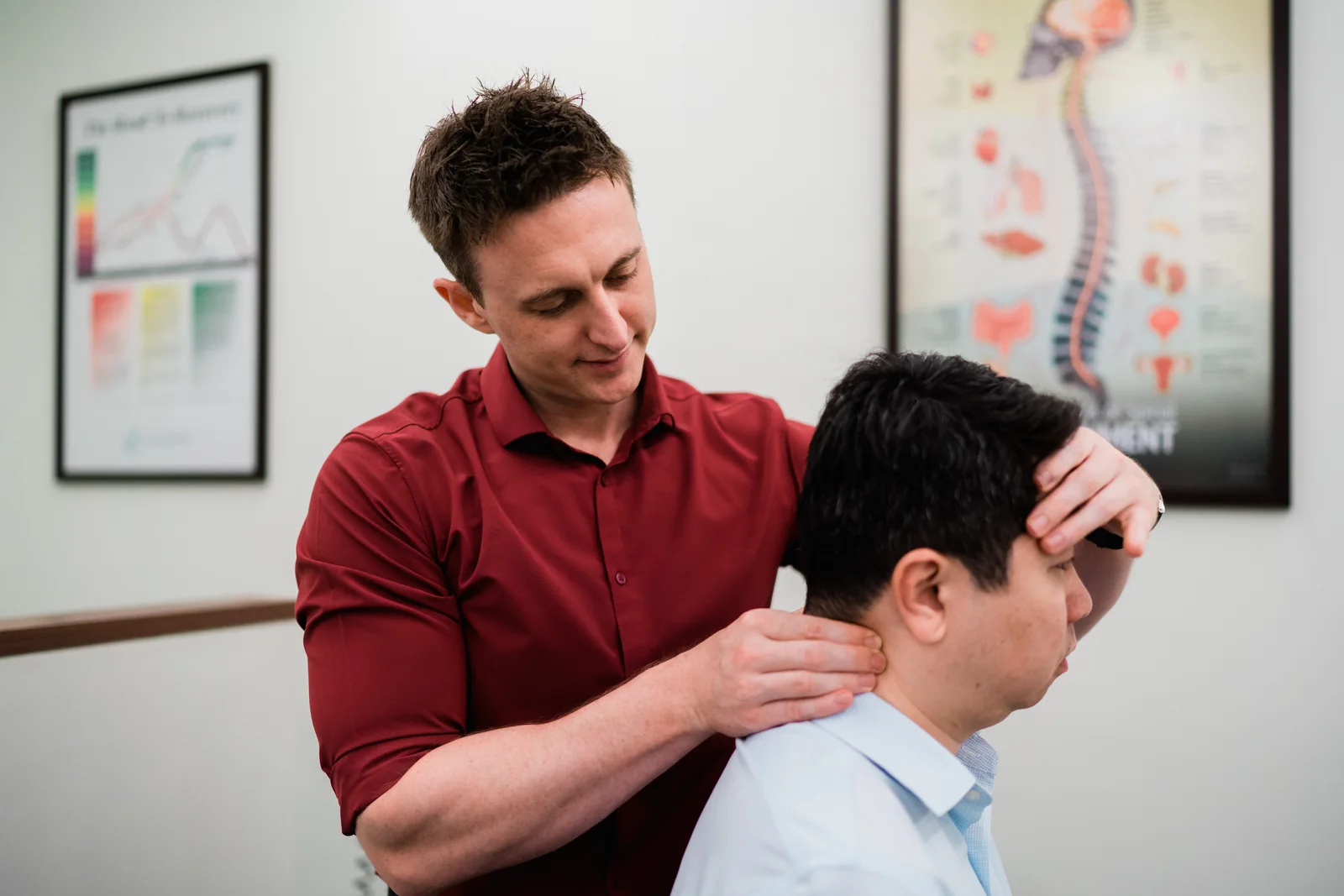
A wry neck is a sudden, painful stiffness in which the head sits tilted to one side and will not move back comfortably. Most people meet it on waking. Turning one way is sharply blocked, while the other way feels close to normal. Most episodes settle within days.
Key takeaways
- Acute wry neck is a sudden loss of neck movement, usually worse to one side.
- It most often begins during sleep, and the pain comes from the neck itself.
- Most episodes ease over several days, and the NHS notes that most neck pain lasts only a few weeks.
- A stiff neck with fever, a worsening headache and light sensitivity can indicate meningitis and is an emergency.
- A stiff neck after a fall, or with arm numbness or weakness, needs assessment rather than stretching.
What is a wry neck?
Wry neck is the everyday name for torticollis, which the National University Hospital in Singapore describes as an abnormal tilt and rotation of the head at rest. In the acute adult form it is where the neck hurts least, so the muscles hold you there.
The structures involved usually sit at one or two levels. The facet joints, the small paired joints at the back of each level of the neck, guide rotation and have a sensitive capsule. The muscles running to the shoulder blade tighten around an irritated segment. In fewer cases the cervical disc is the source.
Congenital muscular torticollis, the infant form in which one side of the neck is tight and holds the head over, is a distinct condition assessed and managed differently.
Why a wry neck so often appears on waking
Sleep holds the neck in one position for hours, with little muscle activity to correct it. A pillow that is too high or too flat, sleeping face down, or a cold draught can leave one side at its end range. The NHS lists sleeping in an awkward position among the common causes of neck pain. That is why so many people simply woke up with a stiff neck.
Clinicians see two patterns. In the common one the pain is sharp, localised to one side, and rotation is blocked in one direction. In the other it is more diffuse, spreads towards the shoulder blade, and settles more slowly, which points to the disc.
That distinction rests on examination findings rather than high-quality research, so it guides handling without being proven.
When a sudden stiff neck needs urgent assessment
A sudden stiff neck is usually benign. Three situations are different.
The first is infection. The NHS lists a stiff neck among the symptoms of meningitis, alongside a high temperature, a worsening headache and eye pain in bright light. It advises calling 999 or going to A&E in that situation.
The second is trauma. A stiff neck after a fall or a vehicle accident needs medical assessment before anyone manipulates it. Rotatory subluxation of the upper two neck vertebrae is rare in adults. A narrative review in Diagnostics notes that this rarity means it is often diagnosed late, with a worse outcome.
The third is nerve involvement. The NHS advises seeing a doctor if neck pain comes with pins and needles or a cold arm. Numbness or weakness in the arm is a reason to be assessed, not stretched.
How long does a wry neck last, and when is it something else?
Most people find the sharpest pain and the worst restriction improve over the first few days, with rotation returning in stages. The NHS states that most neck pain lasts only a few weeks. Where the disc is involved, recovery is slower.
Neck pain that has already lasted weeks or months is a different problem, and the reason it persists is usually not the reason it began. Read our guide to neck pain that will not go away, or our neck pain treatment page.
What to do in the first 48 hours
The aim is to keep the neck moving within comfort while the irritated tissue calms down. Gentle movement inside the range that does not hurt beats holding still, because guarding stiffens the segment.
The NHS advice is specific. Use a low, firm pillow. Apply a cold pack wrapped in a tea towel for about five minutes, three times a day, or a covered hot water bottle for about twenty minutes, two or three times a day. Paracetamol or ibuprofen may help.
The NHS also advises against a neck collar, because keeping the neck moving is better unless a doctor says otherwise. Forcing the head through the blocked direction, cracking your own neck and lying still all day all make matters worse.
Safety note. None of this applies if an urgent sign above is present. Fever with a stiff neck and headache, a recent fall, or symptoms travelling into the arm mean assessment first.
How a wry neck is assessed and treated without surgery or drugs
Assessment comes before anything is done to the neck. A clinician takes the history, measures movement in each direction, and palpates the levels to find the segment involved. A neurological screen of the arm and hand checks sensation, strength and reflexes. A patient who needs medical care instead is referred for it.
A spinal X-ray adds information where needed. An MRI is reserved for surgical consideration, an unclear diagnosis, or a patient not responding.
Treatment is conservative, non-invasive and drug-free, and it works at the source. Once urgent causes are excluded, care usually combines gentle joint mobilisation or a chiropractic adjustment of the affected segment with myofascial release of the guarding muscles, plus a few exercises to restore rotation. Manual treatment of the neck is well-tolerated by most people, and it is not risk-free, which is why screening comes first.
A 2025 systematic review in Systematic Reviews pooled eight randomised controlled trials covering 965 patients with acute neck pain. Spinal manipulative therapy reduced pain and disability and improved range of motion, and no serious adverse events were reported. The authors graded that evidence as low to very low certainty. That is encouraging rather than conclusive, so care is kept short and reviewed at each visit.
How to reduce the chance of it happening again
Prevention is mostly about sleep. The NHS advises keeping your head level with the rest of your body, using a firm mattress, not sleeping on your front, and not twisting the neck in bed.
The rest is about not holding one position for hours. Long stretches at a laptop and a low monitor load the same tissues that give way overnight. Our sitting exercises for desk workers cover a practical set.
Speak to the Team at Elite Spine Centres
If you have woken up unable to turn your head and it is not improving, book a consultation with us. Dr. Bryant has led a multidisciplinary clinical team with chiropractic and osteopathic backgrounds since 2018. An assessment establishes which structure is involved and whether manual treatment suits you.
The clinic is at Parkview Square #14-01, 600 North Bridge Road, Singapore 188778, a short walk from Bugis MRT. Call +65 6904 8400 or message us on WhatsApp at +65 9727 3603. Costs are explained at the assessment.
Frequently Asked Questions
How do you fix a wry neck?
Keep it moving gently within comfort, use heat or a cold pack, and do not force the blocked direction. Persistent cases need assessment.
What causes a wry neck?
Most often irritation of a facet joint and the soft tissues around it, after hours in an awkward sleeping position. Fewer involve the disc.
How long does a wry neck last?
The sharpest pain usually improves within a few days. The NHS states that most neck pain lasts only a few weeks.
Does a wry neck go away?
In most cases it does, provided the neck keeps moving and the blocked direction is not forced. Have it assessed if it is not improving after a week.
Can I drive with a wry neck?
Not while you cannot turn your head properly. The NHS advises against anything dangerous when neck movement is restricted.
Should I see a doctor or a chiropractor for a wry neck in Singapore?
See a doctor first for fever, a severe headache, discomfort in bright light, a recent fall, or arm symptoms. Otherwise a chiropractic or osteopathic assessment is an appropriate start.
Sources
- National Health Service (UK). Neck pain and stiff neck. nhs.uk
- National Health Service (UK). Meningitis. nhs.uk
- National University Hospital, Singapore. Torticollis (Wry Neck). nuh.com.sg
- Diao Y, et al. Efficacy and safety of spinal manipulative therapy in the management of acute neck pain. Systematic Reviews. 2025;14(1):97. doi.org/10.1186/s13643-025-02855-7
- Noriega González DC, et al. C1-C2 rotatory subluxation in adults: a narrative review. Diagnostics. 2022;12(7):1615. doi.org/10.3390/diagnostics12071615
This article is for general information and does not replace a diagnosis from a qualified healthcare professional. Please consult a qualified practitioner about your individual situation.
Speak to a clinician about what is causing your pain.
Your first visit is a 60-minute session with a doctor — a full assessment and your first treatment in the same appointment. We take your clinical history, screen your posture and movement, explain what we find in plain language, and begin treatment if your condition is suitable for our care.