
Shockwave therapy — what it treats and how it works
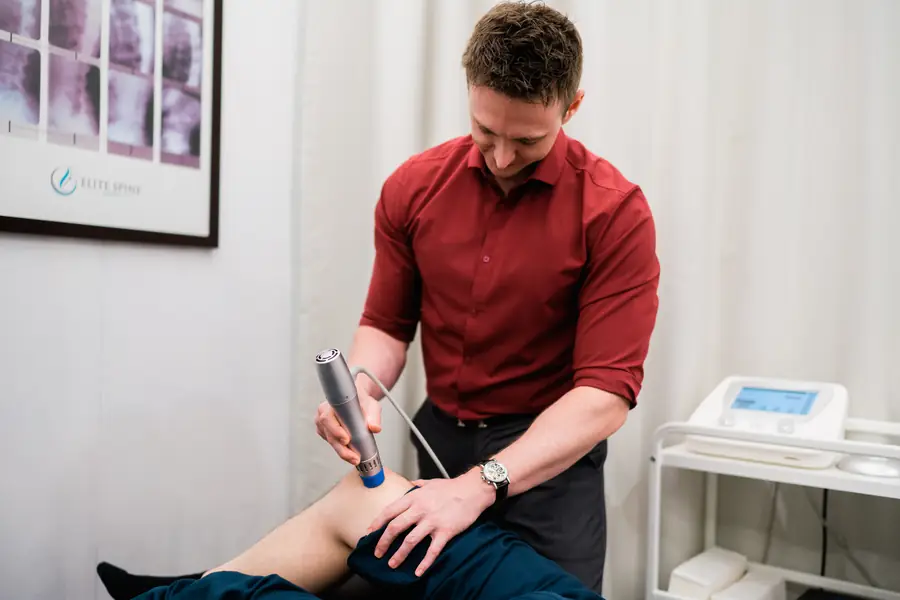
Shockwave therapy is a non-invasive treatment that uses pressure waves to stimulate the body's natural healing process in soft tissue that has stopped recovering on its own. It is most useful for the stubborn, long-standing complaints — persistent tendon pain, heel pain, and chronic soft-tissue conditions — that have not responded to rest or other measures.
Key takeaways
- Shockwave therapy applies focused pressure waves to injured tissue to stimulate blood flow and the body's natural repair process.
- The treatment used here is radial shockwave, which delivers pressure waves across an area of tissue — it is not the same as extracorporeal shockwave lithotripsy used to break kidney stones.
- It is most effective for chronic soft-tissue and tendon conditions, including plantar fasciitis, tennis and golfer's elbow, and frozen shoulder.
- It is non-invasive and drug-free, and a typical course runs over a small number of sessions spaced roughly a week apart.
- An assessment establishes whether shockwave therapy is appropriate for your specific condition.
How shockwave therapy works
Shockwave therapy delivers a series of pressure waves to a targeted area of tissue through a handpiece applied to the skin. These waves create a controlled mechanical stimulus in the tissue below, which increases local blood flow and prompts the body's natural healing process to resume. In chronic injuries, the natural repair response has often stalled; the treatment works by reactivating it, encouraging the tissue to remodel and recover rather than remain in a persistent state of low-grade injury.
The form used at Elite Spine Centres is radial shockwave, which distributes pressure waves across an area of tissue. It is worth clarifying a common confusion: this is a musculoskeletal treatment for soft tissue and is distinct from extracorporeal shockwave lithotripsy, a separate medical procedure used to break down kidney stones.
What shockwave therapy treats
Shockwave therapy is best suited to chronic soft-tissue and tendon conditions that have resisted rest and conservative care. Common applications include plantar fasciitis, the persistent heel pain caused by inflammation of the tissue along the sole of the foot; tennis elbow and golfer's elbow, which are tendon conditions on the outer and inner elbow; Achilles and other tendinopathies; and the stubborn capsular tightness of frozen shoulder. It is generally most valuable where a problem has become long-standing, precisely because those are the cases in which the natural healing response needs to be restarted.
What to expect during treatment
A session is short, usually lasting around fifteen minutes, and requires no anaesthesia or downtime. The handpiece is moved over the affected area while it delivers the pressure waves, and patients typically feel a firm tapping sensation that can be briefly uncomfortable over the most sensitive points, though it is generally well-tolerated. A course usually consists of a small number of sessions spaced roughly a week apart, which allows the tissue time to respond between treatments. The exact number depends on the condition and how long it has been present, and is set out at the assessment.
Is shockwave therapy right for you?
Shockwave therapy is effective for the conditions it suits, but it is one tool among several, and it is not appropriate for every problem. This is why it is applied after a diagnosis rather than as a default. Where a condition is well-matched to it, shockwave therapy is often combined with hands-on treatment and rehabilitation within a structured plan, so the recovery is supported from more than one direction.
Speak to the Team at Elite Spine Centres
If you have a persistent tendon or soft-tissue problem that has not settled with rest, a proper assessment will establish whether shockwave therapy is a suitable part of your treatment plan. To book a consultation, call +65 6904 8400 or message us on WhatsApp at +65 9727 3603.
Frequently Asked Questions
Does shockwave therapy hurt?
Most patients feel a firm tapping sensation that can be briefly uncomfortable over the most sensitive areas, but the treatment is generally well-tolerated and requires no anaesthesia. The intensity can be adjusted during the session.
How many sessions of shockwave therapy will I need?
A course usually runs over a small number of sessions spaced roughly a week apart. The exact number depends on the condition and how long it has been present, and is established at your assessment.
Is there any downtime after shockwave therapy?
No. There is no downtime, and you can return to normal activity after a session. Some patients notice mild, temporary soreness in the treated area, which settles on its own.
Is shockwave therapy the same as the treatment for kidney stones?
No. The shockwave therapy used for muscles and tendons is a musculoskeletal treatment. It is distinct from extracorporeal shockwave lithotripsy, a separate medical procedure used to break down kidney stones.
Speak to a clinician about what is causing your pain.
Your first visit is a 60-minute session with a doctor — a full assessment and your first treatment in the same appointment. We take your clinical history, screen your posture and movement, explain what we find in plain language, and begin treatment if your condition is suitable for our care.