
What Is Piriformis Syndrome, and How Is It Treated?
A deep ache in one buttock that sharpens the longer you sit, then spreads down the back of the thigh, is the pattern most people with piriformis syndrome describe. Piriformis syndrome is irritation of the sciatic nerve where it passes the piriformis muscle, deep in the buttock. It is uncommon, the diagnosis is a clinical one, and most cases respond to conservative treatment.
Key takeaways
- The piriformis is a flat, pyramid-shaped muscle deep in the buttock, and the sciatic nerve runs beneath it in more than 80 per cent of people (StatPearls).
- Published estimates put piriformis syndrome at 0.3 to 6 per cent of cases of low back pain and leg pain (StatPearls).
- Four features point towards it: buttock pain, pain worsened by sitting, tenderness near the greater sciatic notch, and pain on movements that tighten it.
- No scan confirms it, so the diagnosis is clinical and reached by excluding other causes.
- Numbness around the groin, weakness in both legs, or loss of bladder control needs emergency assessment.
What is piriformis syndrome?
The piriformis muscle is flat, oblique and pyramid-shaped. It begins at the front of the sacrum, the triangular bone at the base of the spine, and attaches to the top of the thigh bone. In between it crosses the greater sciatic notch, the gap in the pelvis behind the hip joint.
The muscle rotates the hip outwards, and the sciatic nerve runs very close to it. In more than 80 per cent of people the nerve passes deep to the muscle and leaves the pelvis just below it (StatPearls). An irritated or overworked piriformis muscle can therefore produce nerve pain in the leg.
The evidence deserves plain speaking. Published estimates put the condition at 0.3 to 6 per cent of cases of low back pain and leg pain (StatPearls, Cleveland Clinic). A 2018 systematic review by Hopayian and Danielyan found that neither its true prevalence nor the accuracy of the clinical tests can be settled from the studies so far.
What piriformis syndrome feels like
Hopayian and Danielyan found four features reported most consistently. They are pain in the buttock, pain made worse by sitting, tenderness when a clinician presses near the greater sciatic notch, and pain on movements that increase tension in the muscle. A limited straight leg raise is common, although its absence does not rule the condition out.
People also report aching or burning in the buttock, hip or upper thigh, numbness over the buttock, and tingling along the leg.
What triggers piriformis syndrome, and who tends to get it
Prolonged sitting is the commonest contributor, which places office workers, drivers and cyclists at higher risk. In Singapore, long desk hours with little movement make this the pattern we see most often.
Direct trauma to the hip or buttock can set it off, as can a forceful inward rotation of the hip. Enlargement of the muscle itself is another cause, seen after a sudden rise in training volume.
A smaller group have predisposing anatomy, such as a divided muscle or a sciatic nerve that branches early. StatPearls records a male to female ratio of roughly one to six.
How piriformis syndrome differs from pain starting in the lower back
Treatment follows the source, so this matters most. Most nerve pain down the leg begins in the lower back, where a slipped disc or spinal stenosis presses on a nerve root. Piriformis syndrome produces the same symptoms from elsewhere.
| What you notice | Points to the piriformis muscle | Points to the lower back |
|---|---|---|
| Where the pain sits deepest | In the buttock, behind the hip | In the lower back |
| Pressing the buttock | Reproduces it near the sciatic notch | Tender over the spine instead |
| Sitting | Reliably worsens it | May worsen it; bending matters more |
| Rotating the hip inwards | Reproduces the pain | Usually changes nothing |
The distinction is not always clean. Spinal stenosis and piriformis pain can look similar, and the two can coexist, so a careful examination of both the lumbar spine and the hip is the only sensible starting point. If your symptoms point more to a disc, see our pages on sciatica treatment and telling sciatica and a slipped disc apart.
The examination tests a clinician uses
No blood test or scan confirms piriformis syndrome, so the examination carries the weight. A clinician first palpates the muscle from the sacrum to the top of the thigh bone, looking for the tenderness near the sciatic notch that most cases share.
Four named manoeuvres then tension the muscle to see whether the symptoms return. The FAIR test combines flexion, adduction and internal rotation of the hip in lying. The Freiberg test forces the extended thigh inwards, and the Pace test resists abduction and external rotation. The Beatty test has you side-lying, holding the bent upper knee off the couch.
These tests reproduce symptoms rather than prove a cause, and their accuracy is not established, so they are read alongside the history and tests of the lumbar spine. Ultrasound, MRI, CT and nerve conduction studies mainly exclude other explanations.
At Elite Spine Centres, history and physical assessment come first. A spinal X-ray is added where it changes what we do, and an MRI is reserved for an unclear diagnosis or a poor response.
What you can do yourself, and when to stop
Movement comes first, and it is safe. NHS advice for nerve pain down the leg is to keep up normal activities, start gentle exercise early, and avoid long periods of sitting. Walking for a few minutes every hour is the change that most often helps.
A piriformis stretch is straightforward. Lie on your back, bend the painful leg, and draw that knee gently across the body towards the opposite shoulder until you feel a stretch deep in the buttock. Guidance is to stretch two to three times a day.
Stop and arrange an assessment if a stretch sharply increases the leg pain or brings on numbness. Numbness around the groin or anus, weakness in both legs, or any change in bladder or bowel control belongs in a hospital emergency department the same day.
How piriformis syndrome is treated without surgery or drugs
Conservative care is the mainstay, and published reviews support both manual therapy and stretching. Where evidence is weaker it is fair to say so. Corticosteroid injection helps some people, reports on botulinum toxin are largely anecdotal with short-lived relief, and surgery is a last consideration with unpredictable results.
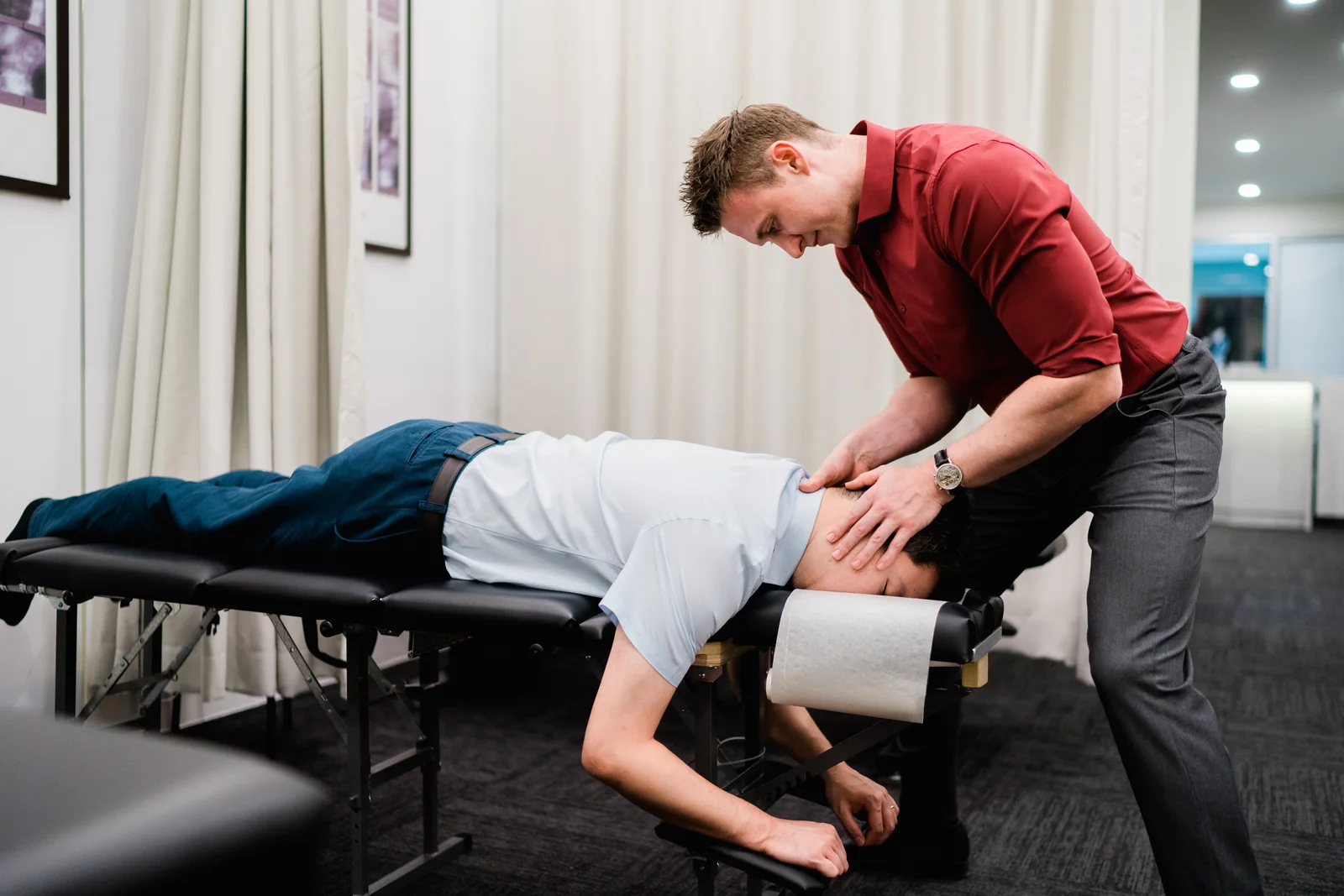
Treatment here begins by releasing the muscle and restoring movement at the hip and pelvis. Myofascial release addresses the tight band of muscle and the fascia around it. Radial shockwave therapy may be added for a stubborn soft-tissue problem, and it is effective for a wide range of soft-tissue problems.
What determines whether relief lasts is the exercise work. Rehabilitative exercises address the hip strength, mobility and sitting habits behind the problem. Clinical reviews report recovery within one to three weeks of starting an exercise programme, with relapse common when the exercises stop.
Speak to the Team at Elite Spine Centres
If buttock pain and leg symptoms are not settling, an assessment will establish whether the piriformis muscle, the lumbar spine, or both are responsible. Our clinicians work non-invasively and drug-free, treating the underlying issue. To book a consultation, call +65 6904 8400 or message us on WhatsApp at +65 9727 3603.
Frequently Asked Questions
How do you fix piriformis syndrome?
Almost always conservatively: manual therapy to release the muscle, a regular piriformis stretch, hip strengthening, and less uninterrupted sitting. Injections are considered only if that fails.
What triggers piriformis syndrome?
Prolonged sitting most often, then direct trauma to the hip or buttock, a forceful inward twist, or a sudden rise in training load.
Can piriformis syndrome go away on its own?
It often settles with activity changes and stretching, usually over weeks. It also recurs readily once the exercises stop.
What are the symptoms of a trapped nerve in the piriformis muscle?
Aching, burning or shooting pain in the buttock that travels down the back of the thigh, with numbness or tingling. Sitting worsens it.
Which clinician should I see for buttock pain in Singapore?
One who will examine both the lumbar spine and the hip, because the two sources look alike and the treatment differs.
Sources
- Hicks BL, Lam JC, Varacallo MA. Piriformis Syndrome. StatPearls [Internet]. StatPearls Publishing; last update 4 August 2023. ncbi.nlm.nih.gov
- Hopayian K, Danielyan A. Four symptoms define the piriformis syndrome: an updated systematic review of its clinical features. Eur J Orthop Surg Traumatol. 2018 Feb;28(2):155-164. pubmed.ncbi.nlm.nih.gov
- Cleveland Clinic. Piriformis Syndrome: Symptoms, Causes and Treatment. Last reviewed 13 July 2022. my.clevelandclinic.org
- National Health Service. Sciatica. Page last reviewed 3 December 2024. nhs.uk
This article is for general information and does not replace a diagnosis from a qualified healthcare professional. Please consult a qualified practitioner about your individual situation.
Speak to a clinician about what is causing your pain.
Your first visit is a 60-minute session with a doctor — a full assessment and your first treatment in the same appointment. We take your clinical history, screen your posture and movement, explain what we find in plain language, and begin treatment if your condition is suitable for our care.