
What Causes a Neck Hump, and Can It Be Corrected?
Most people notice a neck hump in a photograph taken from the side, or in a mirror. It is a rounded bump at the base of the neck, and it has four different causes. Those are thickened muscle and soft tissue, an increased curve in the upper spine, a fat deposit, and change in the vertebrae. What can change depends on which cause you have.
Key takeaways
- Thickened soft tissue over a forward head position is the common picture in desk-based adults, and it responds to loading work.
- An increased curve of the upper spine, called thoracic kyphosis, may be flexible or fixed, and that decides what can change.
- A soft fatty pad, or buffalo hump, is linked to excess cortisol or certain medications and needs medical care.
- Lying flat without a pillow shows how much of the bump is postural rather than structural.
What is a neck hump?
A neck hump is a visible prominence over the cervicothoracic junction, where the base of the neck meets the upper back. The term describes what you can see, not what is producing it, and two popular names for it mean different things.
A dowager's hump means curvature of the upper spine, or thoracic kyphosis, while a buffalo hump means a build-up of body fat there. Cleveland Clinic notes that the two can feel similar to the touch, so the popular name is not evidence of the cause.
What causes a neck hump?
Four mechanisms account for most neck humps, and more than one can be present at once. Two are musculoskeletal, and two need medical assessment.
Forward head posture and thickened soft tissue
Forward head posture describes a head that sits forward of the shoulders when viewed from the side. It is one of the most common postural deviations of the neck (Yang and colleagues, 2023).
Holding that position shortens the upper trapezius, levator scapulae and suboccipital muscles, while the deep neck flexors lengthen and weaken. The loaded tissue can feel thickened and firm, which adds to the bump even where the bone is normal.
A 2023 review of sixteen randomised controlled trials reported significant improvement in pain and disability after corrective exercises or manual therapy, which makes this the version most likely to change.
An increased curve in the upper spine
The thoracic spine, meaning the twelve vertebrae of the upper and mid back, carries a normal forward curve. Cleveland Clinic gives that curve as 20 to 45 degrees, and kyphosis as a curve greater than 50 degrees.
Kyphosis separates into a flexible form and a fixed form. Postural kyphosis is the most common type and comes from sustained slouching, which stretches the supporting ligaments.
Scheuermann's kyphosis is structural, with wedge-shaped vertebrae. Cleveland Clinic states that changing position or posture does not change that curve, because the vertebrae are not flexible.
A fat deposit at the base of the neck
A buffalo hump is a build-up of adipose tissue, meaning body fat, at the base of the back of the neck. Cleveland Clinic states that the most common cause is excess cortisol, known as Cushing's syndrome, whether from the adrenal glands or from long-term corticosteroid medication.
Antiretroviral therapy for HIV, central obesity and rarer conditions such as Madelung's disease are also listed. Posture work does not address this cause, and Cleveland Clinic advises never stopping a prescription medication unless the prescriber says so.
Vertebral change in older adults
In older adults the curve can have a bony cause. A systematic review of age-related hyperkyphosis notes that affected people may or may not have underlying spinal osteoporosis and vertebral compression fractures (Bansal and colleagues, 2014). In such a fracture a weakened vertebra loses height at the front.
That review puts the prevalence at 20 to 40 per cent of older adults, and Cleveland Clinic adds that hyperkyphosis is common after the age of 40.
How to tell which kind of neck hump you have
No self-check is a diagnosis, but a few observations narrow the field. The principle is flexible against fixed, because a postural component moves and a structural one does not.
Lie flat on your back on a firm surface without a pillow and have somebody look from the side. A hump with a large postural component flattens noticeably, while a fixed curve stays much as it was. The standing equivalent is lifting your breastbone and drawing your head back at a mirror.
Timing is the other clue. A bump that built up over years of desk work is usually postural, while one that appeared over weeks points to a medical cause. Please see a doctor if any of the following applies.
- The hump developed quickly, or with weight gain in the face and abdomen, purple stretch marks or new diabetes.
- You take corticosteroid medication long term, or antiretroviral therapy for HIV.
- The curve has increased over months in an older adult, which warrants assessment for a compression fracture.
- You have numbness, weakness or pins and needles in an arm, or you have become short of breath.
What you can do yourself
Reducing the hours spent in a forward head position is the first step. Raise your screen to eye level, lift your phone towards your eyes, and interrupt long seated periods, as our guide to sitting exercises for desk workers sets out.
The exercises used in trials target the deep neck flexors, the shoulder-blade muscles and the upper back extensors, and one such trial ran twelve sessions across four weeks. A brace can act as a reminder, but it does not change the tissue underneath, as our article on whether posture correctors work explains.
Stop any exercise that produces sharp pain, numbness, tingling or weakness in an arm. If you have osteoporosis or a previous spinal fracture, ask a clinician for a programme suited to your bone health.
Exercise has good support for pain, stiffness and function, while the evidence that it reduces an established curve is thinner. The 2014 review found improvement in at least one measure of posture in eight of thirteen studies, but could not pool the data. The NHS states plainly that physiotherapy exercises reduce pain and stiffness but will not improve the curve.
How a neck hump is assessed and treated
Assessment comes before treatment, and most of it is clinical. A history establishes how long the hump has been present and how quickly it appeared, and the examination checks whether the curve reduces on lying flat.
Imaging is used where it adds information. A spinal X-ray measures the angle of the curve, and an MRI is reserved for surgical consideration, an unclear diagnosis or a patient who is not responding.
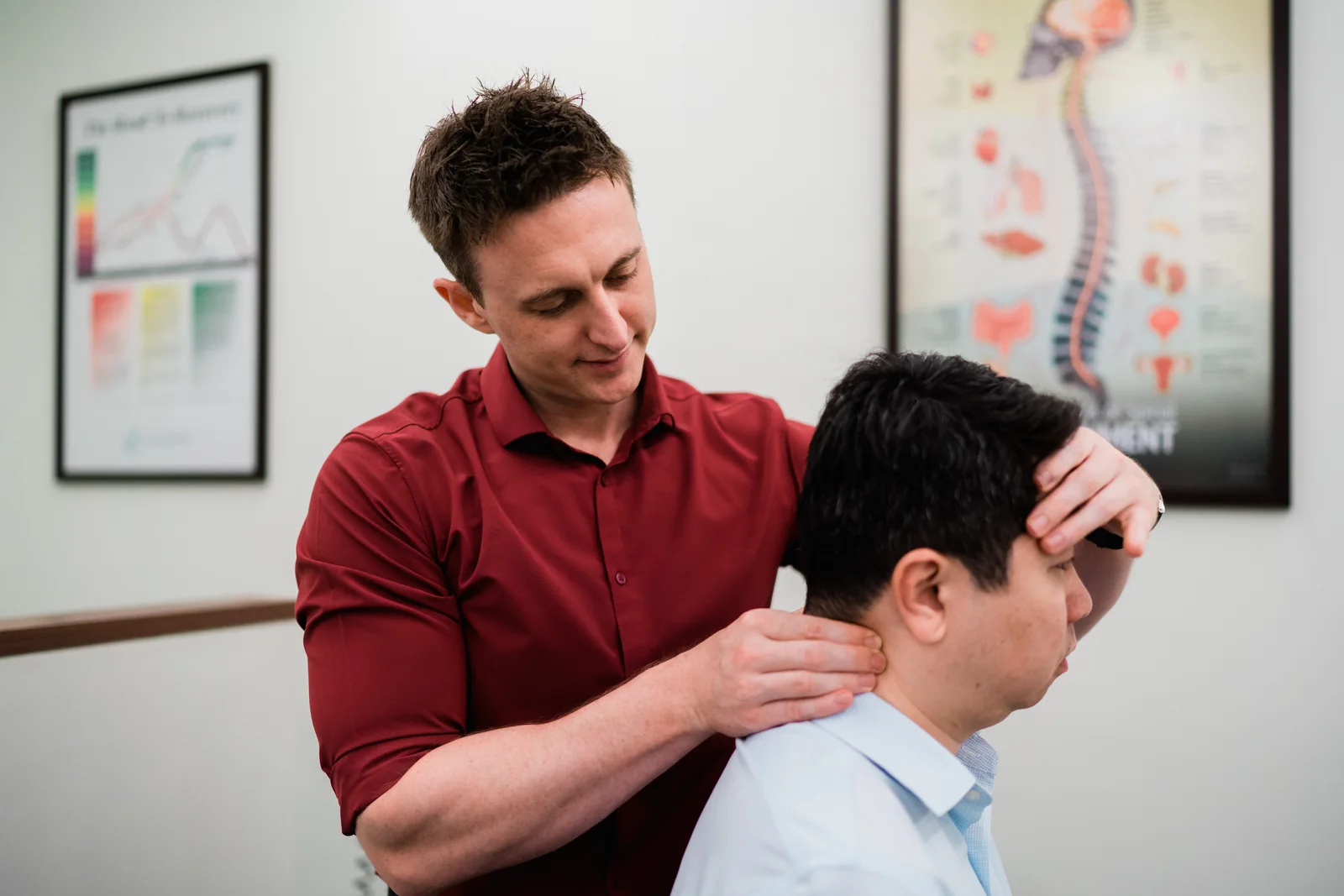
Chiropractic treatment and osteopathy restore movement to the stiff segments of the upper back, and rehabilitative exercises build the deep neck flexors and upper back extensors so a corrected position holds. That is what a posture correction plan consists of.
What conservative care does not do is straighten a fixed structural curve. What can improve is the postural component above it, the soft-tissue tightness, the movement available, and the pain.
Speak to the Team at Elite Spine Centres
If you want to know which kind of hump you have, an assessment is the way to find out. Dr. Bryant has led a multidisciplinary clinical team with chiropractic and osteopathic backgrounds since founding the clinic in 2018, at Parkview Square near Bugis MRT. To book a consultation, call +65 6904 8400 or message us on WhatsApp at +65 9727 3603.
Frequently Asked Questions
Can you get rid of a neck hump?
It depends on the cause. Forward head posture and thickened soft tissue can reduce substantially with treatment and exercise, while a curve set by wedge-shaped vertebrae cannot be straightened. A fatty pad needs its medical cause treated.
How long does it take to fix a neck hump?
No reliable timeframe can be given before an assessment, because it depends on the cause. One exercise trial in forward head posture ran twelve sessions across four weeks, and a long-standing curve takes longer.
Is a neck hump fat or bone?
It can be either, and often it is soft tissue over an increased curve. A fatty pad feels soft and a bony curve feels firm, although Cleveland Clinic notes the two can feel similar.
What is the difference between a dowager's hump and a buffalo hump?
Dowager's hump is used for curvature of the upper spine, or thoracic kyphosis. Buffalo hump is used for a fat deposit at the base of the back of the neck. The two look alike but are managed differently.
Should I see a doctor or a chiropractor first in Singapore?
If the hump appeared over weeks, or with weight gain in the face and abdomen or purple stretch marks, see a doctor first. If it built up gradually alongside desk work, a musculoskeletal assessment is the right start.
Sources
- Cleveland Clinic. Buffalo Hump. my.clevelandclinic.org
- Cleveland Clinic. Kyphosis. my.clevelandclinic.org
- NHS. Kyphosis. nhs.uk
- Yang S, et al. Treatment of Chronic Neck Pain in Patients with Forward Head Posture: A Systematic Narrative Review. Healthcare (Basel). 2023;11(19):2604. pmc.ncbi.nlm.nih.gov
- Bansal S, Katzman WB, Giangregorio LM. Exercise for Improving Age-Related Hyperkyphotic Posture: A Systematic Review. Arch Phys Med Rehabil. 2014;95(1):129-140. pmc.ncbi.nlm.nih.gov
This article is for general information and does not replace a diagnosis from a qualified healthcare professional. Please consult a qualified practitioner about your individual situation.
Speak to a clinician about what is causing your pain.
Your first visit is a 60-minute session with a doctor — a full assessment and your first treatment in the same appointment. We take your clinical history, screen your posture and movement, explain what we find in plain language, and begin treatment if your condition is suitable for our care.