
What Is Golfer's Elbow, and Why Does the Inside of the Elbow Hurt?
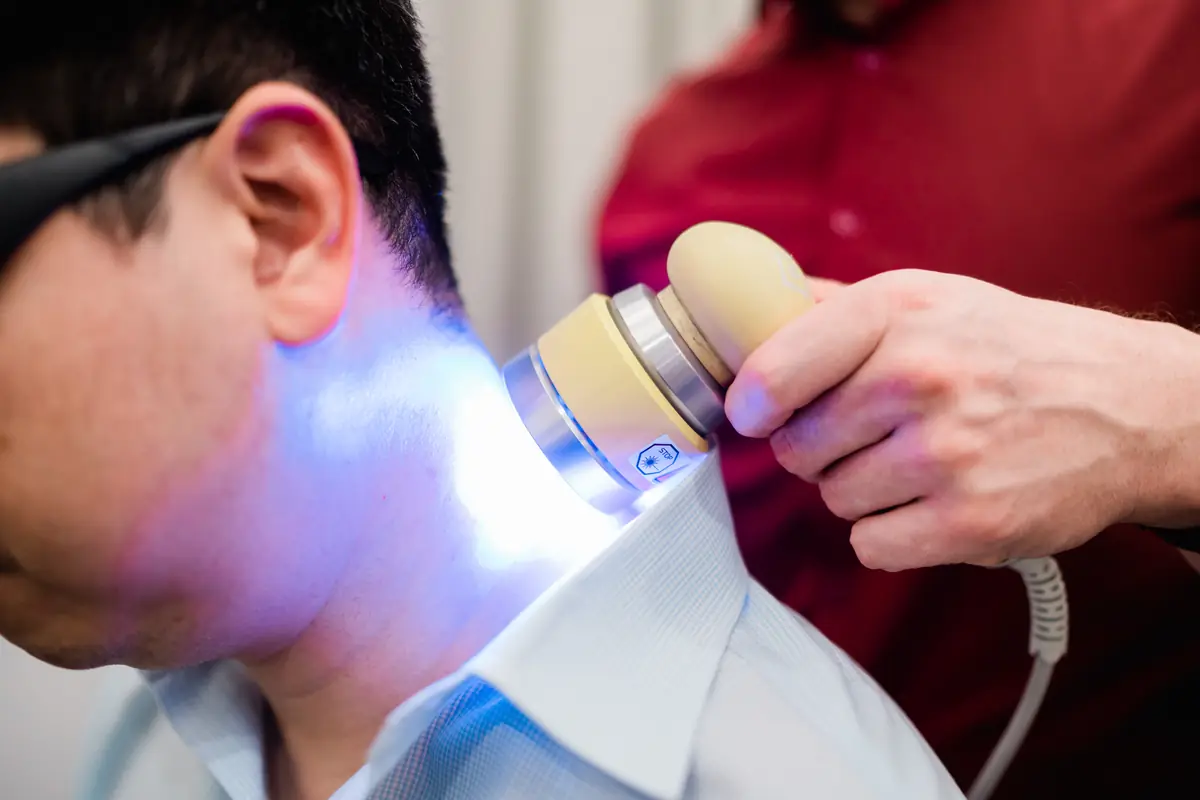
Golfer's elbow, known clinically as medial epicondylitis, is pain and tenderness on the inside of the elbow, where the forearm flexor tendons attach to the bone. It is provoked by gripping, lifting and bending the wrist, and the ache often spreads into the forearm. More than 90 per cent of patients improve without surgery.
Key takeaways
- Golfer's elbow is a tendon problem at the medial epicondyle, the bony point on the inside of the elbow.
- Despite the name, more than 90 per cent of cases are not sports-related, and repeated forceful gripping is the strongest association.
- The usual picture is aching inner elbow pain, tenderness just below the bony point, and a weaker grip.
- Tennis elbow sits on the outside of the elbow, and a nerve problem can imitate this condition closely.
- Recovery is measured in weeks to months, and graded loading of the wrist flexors is what changes the tendon tissue.
What is golfer's elbow?
The medial epicondyle is the bony point on the inside of the elbow. It is the shared attachment of the flexor-pronator muscles, which bend the wrist and turn the palm downwards. Those muscles merge into a common flexor tendon about 3cm long.
Load travelling from the hand into the arm concentrates at that attachment, which is why the pain is so localised. Tenderness usually sits 5 to 10mm below and slightly in front of the bony point.
The older name tendinitis is misleading. Tissue studies show that inflammatory cells are minimal or absent, and that the tendon carries disorganised collagen and abnormal blood vessel growth. That degenerative change is called tendinosis, and it explains why anti-inflammatory medication dulls the pain without altering the tissue.
What causes golfer's elbow, and is golf really to blame?
The name describes a minority of patients. More than 90 per cent of cases are not sports-related. The strongest associations are repeated forceful gripping, handling loads heavier than 20kg, and work with vibrating tools in trades such as carpentry and construction.
Where sport is responsible, the loads are specific. Golf loads the inner elbow during the backswing and just before impact, and throwing loads it during the late cocking phase. Weight training is a frequent cause outside sport, particularly curling the wrists under load.
The research does not break these causes down by country, so there is no Singapore figure to quote. It does support the pattern worth looking for here: repeated gripping and loaded wrist flexion at work and in the gym explain far more cases than golf.
What golfer's elbow feels like
The onset is usually gradual, and an ache builds on the inside of the elbow. Everyday loading provokes it: gripping, lifting with the palm down, turning a doorknob and shaking hands.
Patients often describe stiffness, pain on making a fist, and a weaker grip. Numbness or tingling in the ring and little fingers points to irritation of the ulnar nerve alongside the tendon problem. On examination, the confirming finding is pain on resisted wrist flexion and forearm rotation.
Golfer's elbow or tennis elbow? How the two are told apart
The difference is a matter of side and of movement. Tennis elbow is lateral epicondylitis, which affects the extensor tendons on the outside of the elbow and is provoked by resisted wrist extension. Golfer's elbow affects the flexor tendons on the inside, and resisted wrist flexion reproduces it. Tennis elbow is also the more common of the two: medial epicondylitis accounts for only 10 to 20 per cent of epicondylitis cases. Our guide to exercises for tennis elbow covers that condition.
Several other problems produce pain in the same place. Cubital tunnel syndrome, compression of the ulnar nerve at the elbow, is the closest imitator, and it accompanies the tendon problem in about 20 per cent of patients. Irritation of the C6 or C7 nerve roots in the neck can refer pain to the medial elbow, as can an ulnar collateral ligament sprain or elbow osteoarthritis.
In a growing child, this pain may instead come from an injury to the growth area at the medial epicondyle, a distinct condition that is managed differently. In an adult, nerve conduction studies separate a tendon problem from a nerve-related problem.
What you can do yourself, and when to stop
The first step is to reduce the load that provokes the pain: less forceful gripping, less heavy lifting, and no loaded wrist curling for a period. A counterforce forearm strap worn just below the elbow lowers the load reaching the tendon.
Strengthening is what changes the tendon. The evidence supports eccentric loading of the wrist flexors and pronators, which means controlling the weight slowly as the wrist lowers. A clinician sets the starting load and progression as part of your rehabilitative exercise plan.
Mild discomfort during an exercise is acceptable, but pain that sharpens through a set, or is worse the next morning, means the load was too high. Arrange an assessment if rest and load changes have not helped, or if there is numbness, tingling or weakness in the hand.
How long golfer's elbow takes to settle
Most patients recover without an operation, and the realistic timeframe is weeks to months. The condition can return if the load that caused it is never addressed. A corticosteroid injection relieves pain for less than six to eight weeks and has been linked to higher recurrence. Surgery is considered only after three to six months of proper non-surgical care.
How golfer's elbow is assessed and treated without surgery
At Elite Spine Centres the assessment comes first, and the diagnosis is clinical. It rests on the history of what loads the pain, palpation of the tendon, resisted wrist testing, and an examination of the ulnar nerve. Imaging is used where it adds information: an X-ray can exclude other causes, and an MRI is reserved for an unclear diagnosis or a poor response.
Treatment is non-invasive and drug-free, and it is built around the Functional Correction Method, the clinic's protocol for addressing the underlying issue. It combines load and technique changes, myofascial release to the flexor-pronator muscles, and a graded eccentric loading programme.
Radial shockwave therapy is one of the physical treatments available, and it is effective for a wide range of soft-tissue problems. The honest position on the evidence at the inner elbow is that it is thin. A systematic review of electrophysical treatments for epicondylitis found 20 randomised trials, and every one of them studied tennis elbow (Dingemanse et al., British Journal of Sports Medicine, 2014). StatPearls lists shockwave therapy among the adjunctive treatments that may help once a tendon problem has persisted beyond six months, by promoting tissue regeneration.
Speak to the Team at Elite Spine Centres
If pain on the inside of your elbow has persisted through rest and load changes, an assessment will establish whether the tendon, the ulnar nerve or the neck is the source. Dr. Bryant has led a multidisciplinary clinical team with chiropractic and osteopathic backgrounds since 2018, and the clinic is a short walk from Bugis MRT. To book a consultation, call +65 6904 8400 or message us on WhatsApp at +65 9727 3603.
Frequently Asked Questions
How do you fix a golfer's elbow?
Reduce the gripping and wrist-flexion loads that provoke it, then rebuild the tendon with graded eccentric strengthening of the wrist flexors. Manual therapy, a counterforce strap and treatments such as radial shockwave therapy are added where the examination supports them.
Will golfer's elbow go away by itself?
It often settles once the load causing it is reduced, but it tends to persist while the gripping and wrist loading continue. Improvement is gradual rather than sudden.
What causes golfer's elbow?
Repeated overload of the flexor-pronator tendons through forceful gripping, wrist flexion and forearm rotation. Manual work, vibrating tools and gym loading account for far more cases than golf does.
What can be mistaken for golfer's elbow?
Cubital tunnel syndrome, which is compression of the ulnar nerve at the elbow, is the most frequent imitator. Irritation of the C6 or C7 nerve roots in the neck, an ulnar collateral ligament sprain and elbow osteoarthritis also produce pain in the same area.
Can I keep training at the gym with golfer's elbow?
Usually yes, with modification rather than a complete stop. Drop loaded wrist curling and grip-heavy work, reduce the weight on pulling exercises, and ask a clinician which loads are safe.
Sources
- Li D, Hammad A, Kaiser K. Medial Epicondylitis (Golfer's Elbow). StatPearls, 2 January 2026. NBK519000
- Mayo Clinic Staff. Golfer's elbow: symptoms and causes. 23 May 2026. mayoclinic.org
- Dingemanse R, Randsdorp M, Koes BW, Huisstede BMA. Evidence for the effectiveness of electrophysical modalities for treatment of medial and lateral epicondylitis. Br J Sports Med 2014;48(12):957-65. PubMed 23335238
This article is for general information and does not replace a diagnosis from a qualified healthcare professional. Please consult a qualified practitioner about your individual situation.
Speak to a clinician about what is causing your pain.
Your first visit is a 60-minute session with a doctor — a full assessment and your first treatment in the same appointment. We take your clinical history, screen your posture and movement, explain what we find in plain language, and begin treatment if your condition is suitable for our care.